Category: Class-7 English Literature

  • Pip Meets a Convict – Full Hindi Translation

    Pip Meets a Convict – English • Hindi • Transliteration

    This post gives the original English text from Great Expectations (adapted), along with its Hindi translation (हिन्दी अनुवाद) and Roman transliteration for correct pronunciation. It is designed for school students and teachers.

    Text – Passage / गद्यांश

    English

    My father’s family name is Pirrip, and my first name Philip, but as a child I couldn’t say either. So, I called myself Pip, and then so did everyone else.

    हिन्दी

    मेरे पिता का पारिवारिक नाम पिरिप है, और मेरा पहला नाम फिलिप, लेकिन बचपन में मैं इनमें से कोई भी नाम ठीक से नहीं बोल पाता था। इसलिए, मैंने खुद को ‘पिप’ कहना शुरू कर दिया, और फिर बाकी सबने भी मुझे इसी नाम से पुकारा।

    Transliteration

    Mere pita ka parivarik naam Pirrip hai, aur mera pehla naam Philip, lekin bachpan mein main inmein se koi bhi naam theek se nahi bol paata tha. Isliye, maine khud ko ‘Pip’ kehna shuru kar diya, aur phir baaki sabne bhi mujhe isi naam se pukara.

    English

    I say that my name is Pirrip because that’s what is written on my father’s tombstone and it is what my sister told me. My sister is married to the blacksmith.

    हिन्दी

    मैं कहता हूँ कि मेरा नाम पिरिप है क्योंकि मेरे पिता की कब्र के पत्थर पर यही लिखा है और मेरी बहन ने मुझे यही बताया था। मेरी बहन की शादी लोहार से हुई है।

    Transliteration

    Main kehta hoon ki mera naam Pirrip hai kyunki mere pita ki kabra ke patthar par yahi likha hai aur meri behen ne mujhe yahi bataya tha. Meri behen ki shaadi lohaar se hui hai.

    English

    We lived in a marshy area, down by the river, a few miles from the sea. One day, I stood in the churchyard and looked over my parents’ tombstone at the dark flat wilderness beyond the churchyard.

    हिन्दी

    हम समुद्र से कुछ मील दूर, नदी के किनारे एक दलदली इलाके में रहते थे। एक दिन, मैं चर्च के कब्रिस्तान में खड़ा था और अपने माता-पिता की कब्र के पत्थर के ऊपर से चर्च के अहाते के पार फैले अंधेरे और समतल वीराने को देख रहा था।

    Transliteration

    Hum samudra se kuch meel door, nadi ke kinare ek daldali ilake mein rehte the. Ek din, main church ke kabristan mein khada tha aur apne mata-pita ki kabra ke patthar ke upar se church ke ahaate ke paar phaile andhere aur samtal veerane ko dekh raha tha.

    English

    It was a cold day. The grey land and the grey sky made me feel sad. I suddenly realized that I was an orphan and I began to cry.

    हिन्दी

    वह एक ठंडा दिन था। उस भूरी जमीन और भूरे आसमान ने मुझे उदास कर दिया। मुझे अचानक एहसास हुआ कि मैं अनाथ हूँ और मैं रोने लगा।

    Transliteration

    Woh ek thanda din tha. Us bhuri zameen aur bhure aasmaan ne mujhe udaas kar diya. Mujhe achanak ehsaas hua ki main anaath hoon aur main rone laga.

    English

    ‘Hold your noise!’ cried a terrible voice. It came from a man who had just stepped out from behind a gravestone. ‘Keep still, or I’ll cut your throat!’

    हिन्दी

    ‘शोर मत मचाओ!’ एक भयानक आवाज चिल्लाई। यह आवाज एक ऐसे आदमी की थी जो अभी-अभी एक कब्र के पत्थर के पीछे से बाहर निकला था। ‘हिलो मत, वरना मैं तुम्हारा गला काट दूंगा!’

    Transliteration

    ‘Shor mat machao!’ ek bhayanak aawaaz chillayi. Yeh aawaaz ek aise aadmi ki thi jo abhi-abhi ek kabra ke patthar ke peeche se bahar nikla tha. ‘Hilo mat, varna main tumhara gala kaat doonga!’

    English

    This man was frightening. He was dressed in rough grey clothes and he had a big iron chain on his leg. He was an escaped convict.

    हिन्दी

    यह आदमी बहुत डरावना था। उसने खुरदरे भूरे कपड़े पहने थे और उसके पैर में लोहे की एक बड़ी ज़ंजीर बंधी थी। वह एक भागा हुआ कैदी था।

    Transliteration

    Yeh aadmi bahut darawana tha. Usne khurdure bhure kapde pehne the aur uske pair mein lohe ki ek badi zanjeer bandhi thi. Woh ek bhaaga hua qaidi tha.

    English

    He was dirty from being soaked in the muddy water from the ditches. He was covered in scratches from nettles and stones. He limped, and shivered, and glared, and growled.

    हिन्दी

    खाइयों के गंदे पानी में भीगने के कारण वह गंदा हो गया था। वह बिछुआ (कंटियाली झाड़ियों) और पत्थरों की खरोंचों से भरा हुआ था। वह लंगड़ा रहा था, कांप रहा था, घूर रहा था और गुर्रा रहा था।

    Transliteration

    Khaaiyon ke gande paani mein bheegne ke kaaran woh ganda ho gaya tha. Woh bichhua aur pattharon ki kharonchon se bhara hua tha. Woh langda raha tha, kaamp raha tha, ghoor raha tha aur gurra raha tha.

    English

    ‘Oh! Don’t cut my throat, Sir,’ I pleaded in terror. ‘Tell me your name!’ said the man. ‘Quick!’

    हिन्दी

    ‘ओह! मेरा गला मत काटो, सर,’ मैंने डर के मारे विनती की। ‘मुझे अपना नाम बताओ!’ आदमी ने कहा। ‘जल्दी!’

    Transliteration

    ‘Oh! Mera gala mat kaato, Sir,’ maine darr ke maare vinti ki. ‘Mujhe apna naam batao!’ aadmi ne kaha. ‘Jaldi!’

    English

    ‘Pip, Sir.’ ‘Once more,’ said the man, staring at me. ‘Louder!’ ‘Pip. Pip, Sir.’

    हिन्दी

    ‘पिप, सर।’ ‘एक बार और,’ आदमी ने मुझे घूरते हुए कहा। ‘ज़ोर से!’ ‘पिप। पिप, सर।’

    Transliteration

    ‘Pip, Sir.’ ‘Ek baar aur,’ aadmi ne mujhe ghoorte hue kaha. ‘Zor se!’ ‘Pip. Pip, Sir.’

    English

    ‘Show me where you live,’ said the man. ‘Point out the place!’ I pointed to where our village lay, a mile from the church.

    हिन्दी

    ‘मुझे दिखाओ तुम कहाँ रहते हो,’ आदमी ने कहा। ‘जगह की ओर इशारा करो!’ मैंने उस ओर इशारा किया जहाँ हमारा गाँव स्थित था, जो चर्च से एक मील दूर था।

    Transliteration

    ‘Mujhe dikhao tum kahan rehte ho,’ aadmi ne kaha. ‘Jagah ki or ishara karo!’ Maine us or ishara kiya jahan humara gaon sthit tha, jo church se ek meel door tha.

    English

    The man looked at me closely. Then he turned me upside down, and emptied my pockets. There was nothing in them but a piece of bread.

    हिन्दी

    आदमी ने मुझे ध्यान से देखा। फिर उसने मुझे उल्टा कर दिया और मेरी जेबें खाली कर दीं। उनमें रोटी के एक टुकड़े के अलावा कुछ नहीं था।

    Transliteration

    Aadmi ne mujhe dhyaan se dekha. Phir usne mujhe ulta kar diya aur meri jebein khaali kar dein. Unmein roti ke ek tukde ke alava kuch nahi tha.

    English

    The upside down view of the church righted itself when he placed me on a high tombstone. I sat, trembling, while he ate the bread ravenously.

    हिन्दी

    जब उसने मुझे एक ऊँचे कब्र के पत्थर पर सीधा बैठाया, तब जाकर मुझे चर्च सीधा दिखाई दिया। मैं काँपते हुए बैठा रहा, जबकि वह उस रोटी को भूख से बेहाल होकर खा रहा था।

    Transliteration

    Jab usne mujhe ek unche kabra ke patthar par seedha baithaya, tab jaakar mujhe church seedha dikhai diya. Main kaampte hue baitha raha, jabki woh us roti ko bhookh se behaal hokar kha raha tha.

    English

    ‘Now look here!’ said the man. ‘Where are your parents?’ ‘There, Sir!’ said I.

    हिन्दी

    ‘अब इधर देखो!’ आदमी ने कहा। ‘तुम्हारे माता-पिता कहाँ हैं?’ ‘वहाँ, सर!’ मैंने कहा।

    Transliteration

    ‘Ab idhar dekho!’ aadmi ne kaha. ‘Tumhare mata-pita kahan hain?’ ‘Wahan, Sir!’ maine kaha.

    English

    The man jumped and made a short run, but then he stopped and looked over his shoulder. ‘There, Sir!’ I timidly said, pointing to the tombstone.

    हिन्दी

    आदमी कूदा और थोड़ी दूर भागा, लेकिन फिर वह रुका और अपने कंधे के ऊपर से पीछे देखा। ‘वहाँ, सर!’ मैंने डरते हुए कब्र के पत्थर की ओर इशारा करते हुए कहा।

    Transliteration

    Aadmi kooda aur thodi door bhaaga, lekin phir woh ruka aur apne kandhe ke upar se peeche dekha. ‘Wahan, Sir!’ maine darte hue kabra ke patthar ki or ishara karte hue kaha.

    English

    ‘Oh,’ said the man. ‘So, who do you live with? If I let you live, which I haven’t made up my mind about.’ ‘My sister, Sir—Mrs Joe Gargery—wife of Joe Gargery, the blacksmith, Sir.’

    हिन्दी

    ‘ओह,’ आदमी ने कहा। ‘तो, तुम किसके साथ रहते हो? अगर मैंने तुम्हें जीने दिया तो—जिसके बारे में मैंने अभी तक फैसला नहीं किया है।’ ‘मेरी बहन, सर—श्रीमती जो गार्गरी—जो गार्गरी, लोहार की पत्नी, सर।’

    Transliteration

    ‘Oh,’ aadmi ne kaha. ‘To, tum kiske saath rehte ho? Agar maine tumhe jeene diya to—jiske baare mein maine abhi tak faisla nahi kiya hai.’ ‘Meri behen, Sir—Shrimati Joe Gargery—Joe Gargery, lohaar ki patni, Sir.’

    English

    ‘Now look here,’ he said, ‘I need to decide if I will let you live. Do you know what a file is?’ ‘Yes, Sir.’ ‘And you know what grub is?’ ‘Yes, Sir.’

    हिन्दी

    ‘अब इधर देखो,’ उसने कहा, ‘मुझे यह तय करना है कि मैं तुम्हें जीने दूँ या नहीं। क्या तुम जानते हो कि रेती (file) क्या होती है?’ ‘जी, सर।’ ‘और तुम जानते हो कि खाना (grub) क्या होता है?’ ‘जी, सर।’

    Transliteration

    ‘Ab idhar dekho,’ usne kaha, ‘Mujhe yeh tay karna hai ki main tumhe jeene doon ya nahi. Kya tum jaante ho ki reti (file) kya hoti hai?’ ‘Ji, Sir.’ ‘Aur tum jaante ho ki khana (grub) kya hota hai?’ ‘Ji, Sir.’

    English

    ‘You get me a file.’ He tilted me again. ‘And you get me grub.’ He tilted me again. ‘You bring them both to me.’ He tilted me again. ‘Or I’ll have your heart and liver out.’

    हिन्दी

    ‘तुम मेरे लिए एक रेती लाओगे।’ उसने मुझे फिर से झुकाया। ‘और तुम मेरे लिए खाना लाओगे।’ उसने मुझे फिर से झुकाया। ‘तुम वे दोनों चीजें मेरे पास लाओगे।’ उसने मुझे फिर से झुकाया। ‘वरना मैं तुम्हारा दिल और जिगर बाहर निकाल लूँगा।’

    Transliteration

    ‘Tum mere liye ek reti laoge.’ Usne mujhe phir se jhukaya. ‘Aur tum mere liye khana laoge.’ Usne mujhe phir se jhukaya. ‘Tum woh dono cheezein mere paas laoge.’ Usne mujhe phir se jhukaya. ‘Varna main tumhara dil aur jigar bahar nikaal loonga.’

    English

    ‘Early tomorrow morning, bring that file and the grub. You bring the lot to me, at that old Battery over there.’

    हिन्दी

    ‘कल सुबह जल्दी, वह रेती और खाना लेकर आना। वह सब कुछ मेरे पास उस पुरानी बैटरी (किले) पर लाना।’

    Transliteration

    ‘Kal subah jaldi, woh reti aur khana lekar aana. Woh sab kuch mere paas us purani battery (kile) par lana.’

    English

    ‘If you do it, and you don’t say a word about me, I will let you live. If you fail… then your heart and your liver shall be torn out, roasted and eaten.’

    हिन्दी

    ‘अगर तुम ऐसा करते हो, और मेरे बारे में एक शब्द भी नहीं कहते हो, तो मैं तुम्हें जीने दूँगा। अगर तुम असफल हुए… तो तुम्हारा दिल और तुम्हारा जिगर बाहर निकाल लिया जाएगा, भुना जाएगा और खाया जाएगा।’

    Transliteration

    ‘Agar tum aisa karte ho, aur mere baare mein ek shabd bhi nahi kehte ho, to main tumhe jeene doonga. Agar tum asphal hue… to tumhara dil aur tumhara jigar bahar nikaal liya jayega, bhuna jayega aur khaya jayega.’

    English

    ‘Now, I’m not alone. There’s a young man hiding with me. In comparison with him I am an angel.’

    हिन्दी

    ‘अब सुनो, मैं अकेला नहीं हूँ। मेरे साथ एक नौजवान छिपा हुआ है। उसकी तुलना में मैं तो एक फरिश्ता हूँ।’

    Transliteration

    ‘Ab suno, main akela nahi hoon. Mere saath ek naujawan chipa hua hai. Uski tulna mein main to ek farishta hoon.’

    English

    ‘A boy can’t hide himself from that young man… that young man will softly creep and creep his way to him and tear him open.’

    हिन्दी

    ‘एक लड़का खुद को उस नौजवान से नहीं छिपा सकता… वह नौजवान धीरे-धीरे रेंगते हुए उस तक पहुँचेगा और उसे चीर देगा।’

    Transliteration

    ‘Ek ladka khud ko us naujawan se nahi chipa sakta… woh naujawan dheere-dheere rengte hue us tak pahunchega aur use cheer dega.’

    English

    I promised, and he took me down from the top of the tombstone. ‘Now,’ he went on, ‘remember that promise, and remember that young man, and get home!’

    हिन्दी

    मैंने वादा किया, और उसने मुझे कब्र के पत्थर के ऊपर से नीचे उतार दिया। ‘अब,’ वह आगे बोला, ‘उस वादे को याद रखना, और उस नौजवान को याद रखना, और घर जाओ!’

    Transliteration

    Maine vaada kiya, aur usne mujhe kabra ke patthar ke upar se neeche utaar diya. ‘Ab,’ woh aage bola, ‘us vaade ko yaad rakhna, aur us naujawan ko yaad rakhna, aur ghar jao!’


    Summary / सारांश

    English Summary

    Pip is a young orphan boy whose parents are dead. He lives with his sister and her husband, Joe Gargery, the blacksmith, in a marshy village near the river, a few miles from the sea. One cold and sad day, while Pip is standing alone in the churchyard and looking at his parents’ graves, a frightening man suddenly appears. This man is an escaped convict, dirty, chained and desperate. He threatens Pip and forces him to bring a file to cut the iron from his leg and some food from home. Out of fear for his life, Pip promises to help the man and is finally released. Shaken and terrified, Pip goes home, remembering the man’s threats and the mention of a mysterious young companion.

    हिन्दी सारांश

    पिप एक छोटा अनाथ लड़का है, जिसके माता-पिता अब नहीं रहे। वह अपनी बड़ी बहन और बहनोई जो गार्गरी (लोहार) के साथ नदी के किनारे स्थित दलदली गाँव में रहता है। एक ठंडे और उदास दिन पिप अकेला चर्च के कब्रिस्तान में खड़ा होकर अपने माता-पिता की कब्रों को देख रहा होता है। तभी अचानक एक भयानक आदमी उसके सामने आ जाता है। यह आदमी जेल से भागा हुआ कैदी है, जो गंदा, जंजीरों में जकड़ा और बहुत परेशान है। वह पिप को डरा-धमकाकर कहता है कि वह उसके लिए लोहे की ज़ंजीर काटने के लिए एक रेती (file) और घर से खाना चुराकर लाए। अपनी जान के डर से पिप उससे मदद करने का वादा कर देता है। कैदी उसे छोड़ देता है, लेकिन जाते-जाते एक और खतरनाक नौजवान का नाम लेकर और भी डरावनी धमकी देता है। डरा हुआ पिप घर की ओर लौटता है और उस वादे तथा धमकी को बार-बार याद करता है।

    Transliteration

    Pip ek chhota anaath ladka hai, jiske mata-pita ab nahi rahe. Vah apni badi behen aur bahinoyi Joe Gargery (lohaar) ke saath nadi ke kinare sthit daldali gaon mein rehta hai. Ek thande aur udaas din Pip akela church ke kabristan mein khada hokar apne mata-pita ki kabron ko dekh raha hota hai. Tabhi achanak ek bhayanak aadmi uske saamne aa jaata hai. Yah aadmi jail se bhaaga hua qaidi hai, jo ganda, zanjeeron mein jakda aur bahut pareshaan
  • Ch.13 Poor Cinderella

    Poor Cinderella, whose stepmom was mean,

    could never see films rated PG-13.

    गरीब सिंड्रेला, जिसकी सौतेली माँ बहुत कठोर थी,

    PG-13 रेटिंग वाली फ़िल्में वह कभी नहीं देख सकती थी।

    She hadn’t a cell phone and no DVD,

    no notebook computer or pocket TV.

    उसके पास न मोबाइल फोन था, न कोई DVD,

    न नोटबुक कंप्यूटर था, न ही पॉकेट TV।

    She wasn’t allowed to play video games.

    The tags on her clothes had unfashionable names.

    उसे वीडियो गेम खेलने की भी अनुमति नहीं थी।

    उसके कपड़ों पर लगे टैग बिल्कुल भी फ़ैशनेबल नहीं थे।

    Her shoes were not trendy enough to be cool.

    No limousine chauffeur would drive her to school.

    उसके जूते इतने आधुनिक नहीं थे कि कोई उन्हें स्टाइलिश कहे।

    कोई लिमोज़ीन चालक उसे स्कूल ले जाने नहीं आता था।

    Her house had no drawing room; only a den.

    Her bedtime, poor darling, was quarter past ten!

    उसके घर में ड्रॉइंग रूम नहीं था, बस एक छोटा-सा कमरा था।

    और उसकी सोने का समय, बेचारी की, रात सवा दस बजे था!

    —

    Well one day Prince Charming declared that a ball

    would be held in his honour and maidens from all

    over the kingdom were welcome to come

    and party to techno and jungle house drum.

    एक दिन प्रिंस चार्मिंग ने घोषणा की कि उनके सम्मान में एक नृत्य-समारोह होगा,

    और पूरे राज्य की युवतियों को वहाँ आने का निमंत्रण होगा,

    जहाँ वे टेक्नो और जंगल हाउस ड्रम संगीत पर नृत्य कर सकेंगी।

    —

    But Poor Cinderella, with nothing to wear,

    collapsed in her stepmother’s La-Z-Boy chair.

    पर गरीब सिंड्रेला के पास पहनने के लिये कुछ भी नहीं था,

    और वह अपनी सौतेली माँ की लेज़ी-बॉय कुर्सी पर ढहकर बैठ गयी।

    She let out a sigh, with a lump in her throat,

    then sniffled and picked up the TV remote.

    उसने एक गहरी साँस छोड़ी, गले में रुकावट-सी महसूस हुई,

    फिर नाक पोंछी और टीवी का रिमोट उठा लिया।

    She surfed channel zero to channel one-ten

    then went back to zero and started again.

    वह चैनल शून्य से लेकर चैनल एक-सौ-दस तक बदलती रही,

    फिर वापस शून्य पर आयी और फिर से वही क्रम शुरू कर दिया।

    She watched music videos, sitcoms and sports,

    commercials and talkshows and weather reports.

    उसने संगीत वीडियो देखे, सिटकॉम देखे, खेल देखे,

    विज्ञापन, टॉक शो और मौसम की रिपोर्टें भी देखीं।

    —

    But no fairy godmother came to her side

    to offer a dress or a carriage to ride.

    पर कोई परी-गॉडमदर उसके पास नहीं आयी,

    न उसने कोई पोशाक दी, न कहीं जाने के लिये गाड़ी।

    So Poor Cinderella’s been sitting there since,

    while one of her stepsisters married the Prince.

    इसलिये बेचारी सिंड्रेला तब से वहीं बैठी है,

    और उसकी एक सौतेली बहन ने राजकुमार से शादी तक कर ली।

    She sits there and sadly complains to the screen,

    if only her stepmother wasn’t so mean.

    वह आज भी वहीं बैठकर स्क्रीन से दुःख-भरे स्वर में कहती है—

    “काश मेरी सौतेली माँ इतनी कठोर न होती।”

    — Kenn Nesbitt

  • Chapter – 15 The Alien 👽 Visitor 🚀

    Understanding

    1. What came out of the saucer-like aircraft?
      A creature, the alien, came out of the saucer-like aircraft.
    2. How did the alien creature wish the boy?
      The alien greeted the boy by saying, “Ο Earthling! Greetings!” and then rolled on the floor.
    3. Why do you think the boy was blabbering and stuttering?
      The boy was blabbering and stuttering because he was scared, surprised, and nervous to meet the alien.
    4. What had the alien come to Earth to study?
      The alien had come to study human emotions and behaviors—specifically why humans laugh when happy and cry when sad.
    5. What explanation did the boy give?
      The boy explained that humans laugh when they are happy, and cry when they are sad.
    6. How did the alien transfer all the boy’s data?
      The alien transferred the boy’s data by putting a finger on his head and making a whirring sound that took all the information from his brain.
    7. What gift did the alien give to the boy?
      The alien gave the boy a torch that would always have light.
    8. List some of the differences between the alien and the boy.
    • The alien was not born, it created itself when needed, and it did not breathe.
    • The alien had no life span (“no shelf life”), while humans live and then die.
    • The alien could enter through walls without knocking, unlike humans.
    • The alien could transfer information directly from the brain, while humans use speech.

  • Chapter -14  Pip 🤭Meets The Convict🦹‍♀️

    Understanding


    1. Who do you think the man Pip meets in the churchyard could be? What specific word or description is used to refer to him?

    The man Pip meets in the churchyard is a convict (a person who has escaped from prison). In the story, he is described as “a fearful man, all in coarse gray, with a great iron on his leg.” The word “convict” is not directly used by Pip, but this description makes it clear.


    2. Identify the words or phrases that Pip uses to describe his parents. How does he come to think that they had these particular qualities?

    Pip never saw his parents. He guesses what they looked like from the writings on their tombstones. For example, he thinks his father was “a square, stout, dark man, with curly black hair” because of the shape of the letters on his gravestone. He believes his mother was “freckled and sickly” because of the “character and turn of the inscription” on her tombstone.


    3. What expression or phrase in the text suggests that Pip’s five brothers passed away at a very young age?

    The phrase “five little stone lozenges…sacred to the memory of five little brothers of mine—who gave up trying to get a living exceedingly early in that universal struggle” suggests his brothers died very young.


    4. Find the words in the second paragraph that depict the churchyard, the marshes, the river, and the sea.

    • Churchyard: “this bleak place overgrown with nettles was the churchyard”
    • Marshes: “the dark flat wilderness beyond the churchyard, intersected with dykes and mounds and gates, with scattered cattle feeding on it, was the marshes”
    • River: “the low leaden line beyond was the river”
    • Sea: “the distant savage lair from which the wind was rushing, was the sea”

    5. At what location and time of day does Pip’s meeting with the convict take place?

    Pip meets the convict in the churchyard, which is next to his parents’ graves, on a raw afternoon towards evening.


    6. List the convict’s words and actions that create fear in Pip.

    • He shouts at Pip: “Hold your noise!” and threatens, “I’ll cut your throat!”
    • He grabs Pip by the chin and turns him upside down.
    • He eats Pip’s bread “ravenously.”
    • He grabs Pip and tilts him back to scare him.
    • He threatens, “Or I’ll have your heart and liver out.”
    • He warns Pip not to tell anyone, or else he and another “young man” will find him.

    7. Why do you think the convict repeatedly glances at his leg and at Pip when he hears that Pip’s sister is married to a blacksmith?

    He glances at his leg because it has an iron shackle on it—he is an escaped prisoner. When he hears Pip’s sister is married to a blacksmith (someone who can work with metal), he may worry Pip’s family could help catch him or remove the shackle.


    8. Why do you think the convict is asking for a file? What do you think he plans to do with it?

    The convict needs the file to cut through the iron shackle on his leg so he can escape more easily.


    9. When the convict threatens Pip with dire consequences, what do these threats reveal about his personality or state of mind?

    His threats show he is desperate, frightened, and maybe very angry. He is doing whatever he can to make sure Pip obeys, even saying scary things to keep himself safe from being caught.


    10. What makes the convict say, ‘I wish I was a frog, or an eel?’

    He says that because he is outside in the cold, wet marsh, wishing he could live in or handle the harsh, muddy, and wet conditions as easily as a frog or an eel can.


    11. Why do you think the convict warns Pip not to mention him to anyone?

    He warns Pip so that Pip doesn’t tell others and the convict won’t get caught by the police or townspeople. The warning is to keep himself safe.


    A. Make a list of compound words that appear in the story.

    Here are some compound words you can find in the story “Pip Meets the Convict”:

    • tombstone
    • blacksmith
    • churchyard
    • weathercock
    • tombstone
    • footstep
    • gravestone
    • heartless (if used in extended text)
    • inside (sometimes written as one word)

    B. Make compound words by combining the following words:

    Let’s try making some compound words by putting two from your list together. Here are some examples:

    1. bed + room = bedroom
    2. foot + ball = football
    3. tail + bone = tailbone
    4. card + board = cardboard
    5. door + bell = doorbell
    6. fire + place = fireplace
    7. air + port = airport
    8. eye + brow = eyebrow
    9. book + mark = bookmark
    10. sun + light = sunlight
    11. mat + card = matcard
    12. rain + coat = raincoat
    13. day + light = daylight
    14. book + fair = bookfair
    15. time + table = timetable
    16. finger + print = fingerprint
    17. land + mark = landmark
    18. foot + step = footstep

    Question – C Page- 135

    State which of the following sentences are incorrect:


    1. On every Saturday, after the cricket match, Raju would often come home completely exhausted.

    • CORRECT.
      You can use “would often” to describe a repeated past action.

    2. She used to like him… Yes, but now she dislikes him!

    • CORRECT.
      “Used to” here tells us about a past state/habit that has changed.

    3. She would live in Spain before the war, and then she moved to London.

    • INCORRECT.
      We can’t use “would” to talk about a single past state. Instead, use “used to”:
    • Correct version: “She used to live in Spain before the war, and then she moved to London.”

    4. I remember we would go fishing every morning when I was a child. It was great. Now, I work as an accountant and don’t have any free time.

    • CORRECT.
      “Would go fishing” shows a repeated habit in the past.

    5. The children would often help me bake a cake. They still do sometimes.

    • CORRECT.
      “Would often help” is fine for a repeated past action, and it makes sense with “They still do sometimes.”

    6. She would be a great dancer until she injured her right foot.

    • INCORRECT.
      This is about a state/ability, not a repeated action. Use “used to”:
    • Correct version: “She used to be a great dancer until she injured her right foot.”

    7. My uncle would always look happy before he lost his property five years ago.

    • CORRECT.
      “Would always look happy” is a repeated/regular past condition.

    8. He would never punish anyone himself; he always had someone else do it for him.

    • CORRECT.
      This describes a habitual or repeated action in the past.

    Summary – Incorrect Sentences are:

    • 3. She would live in Spain before the war, and then she moved to London.
    • 6. She would be a great dancer until she injured her right foot.

    Writing

    Here’s a short character sketch of the Convict using words and expressions discussed earlier:


    Character Sketch of the Convict

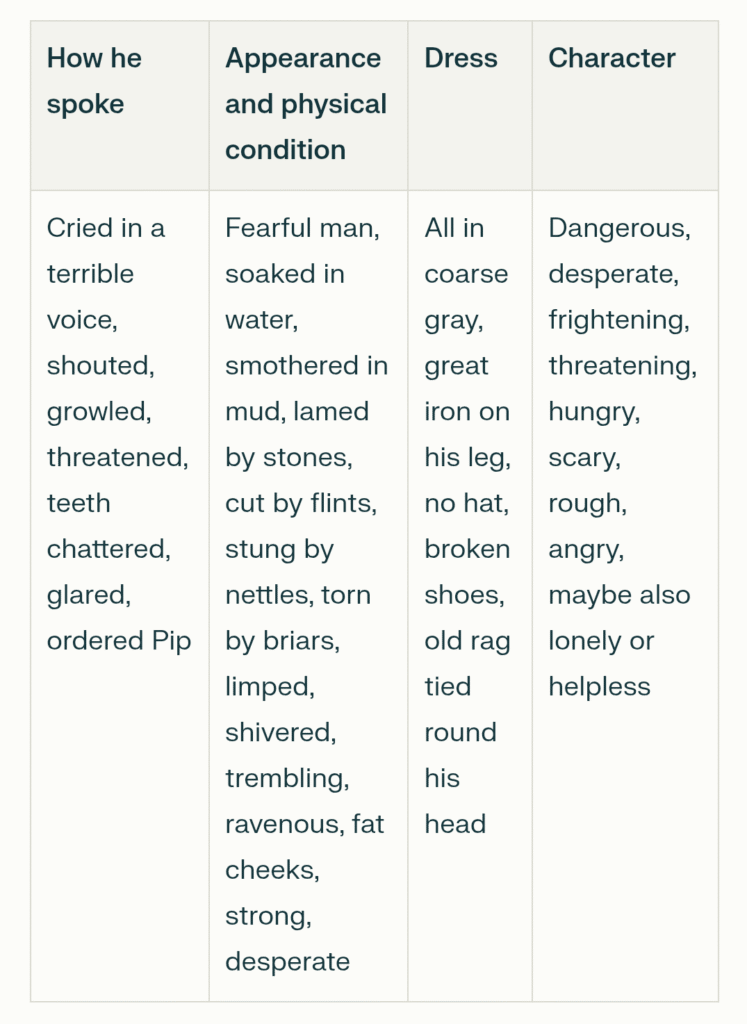
    The convict is a fearful and desperate man who seems very rough and dangerous at first. He appears soaked in water, smothered in mud, lamed by stones, and torn by briars, which shows that he has been through a lot of suffering. He wears coarse gray clothes, has a great iron on his leg, no hat, broken shoes, and an old rag tied around his head—all of which make him look poor and miserable.

    The convict’s actions and words are frightening: he shouts, threatens, grabs Pip, and glares with chattering teeth. He scares Pip by threatening to cut his throat and saying he would take out his heart and liver if Pip didn’t help him. All these actions reveal that the convict is very desperate to survive and escape. Deep inside, he seems sad, lonely, and in great trouble, which makes him act rough and scary.

    Though the convict frightens Pip, his hunger and tiredness also show he is just a man in need—the iron on his leg and his appearance suggest he is an escaped prisoner running from the law, not by choice, but by force of hard circumstances.


  • Chapter – 13 Poor 🧝‍♀️ Cindrella

    Understanding

    1. Name at least five things which Cinderella could not do because of her mean stepmother.
    • Cinderella could not watch films rated PG-13.
    • She didn’t have a cellphone.
    • She didn’t have a DVD or notebook computer.
    • She wasn’t allowed to play video games.
    • Her clothes and shoes were unfashionable and not trendy.
    1. Pick out the line which says that the dresses she wore were not of a new style.
    • “The tags on her clothes had unfashionable names.”
    1. Do you think Cinderella wanted to be a very rich and important person?
    • No, Cinderella did not want to be very rich or important; she just wanted to enjoy simple things and be treated kindly.
    1. Whom did Prince Charming invite to his party?
    • Prince Charming invited maidens (young ladies) from all over the kingdom.
    1. Why did Cinderella fall down into her stepmother’s chair?
    • Cinderella fell down into her stepmother’s chair because she was sad and had nothing nice to wear for the ball.
    1. Pick out two expressions from stanza 3 that show that Cinderella was very unhappy.
    • “She let out a sigh, with a lump in her throat,”
    • “then sniffled and picked up the TV remote.”
    1. Why did she surf the TV channels?
    • She surfed the TV channels because she was bored and trying to find something to watch while feeling lonely and sad.
    1. How does the story end?
    • The story ends with Cinderella still sitting sadly watching TV, while one of her stepsisters married the Prince.
    1. Do you think Cinderella’s stepmother was really mean or that Cinderella’s demands were unreasonable?
    • Cinderella’s stepmother was really mean because she did not let Cinderella have fun or nice things, and Cinderella’s demands were reasonable as she only wanted some happiness and kindness.

    Here are 6 electronic gadgets and 6 TV programmes mentioned in the poem “Poor Cinderella”:

    Electronic Gadgets:

    • Cellphone
    • DVD
    • Notebook computer
    • Pocket TV
    • TV
    • TV Remote

    TV Programmes:

    • Music videos
    • Sitcoms
    • Sports
    • Commercials
    • Talk shows
    • Weather reports