Category: Class-7 English Literature

  • Chapter – 7 Caged Bird

    Understanding

    1. Read stanzas 1 and 4 again and make a list of things/actions that a bird has the freedom to do.

    • Leaps on the back of the wind
    • Floats downstream
    • Dips his wing in the orange sun rays
    • Dares to claim the sky
    • Thinks of another breeze
    • Feels the trade winds through the trees
    • Eats fat worms on a dawn-bright lawn
    • Names the sky his own

    2. How is the caged bird different from the free bird? List the limitations of the caged bird.

    The caged bird is trapped and unable to fly freely. Its limitations include:

    • Stalks down his narrow cage
    • Wings are clipped
    • Feet are tied
    • Can seldom see through his bars of rage
    • Stands on the grave of dreams
    • Shadow shouts on a nightmare scream

    The free bird can move, fly, and explore wherever it wishes; the caged bird is physically and emotionally restricted.

    3. How does the caged bird express its desires? What does it long for?

    The caged bird expresses its desires by singing with a fearful trill about “things unknown but longed for still.” It longs for freedom.

    4. What is the main concern of the poem?

    The poem’s main concern is the contrast between freedom and captivity, symbolizing the longing for liberty and the pain of being oppressed or confined.

    5. Pick out the rhyming words from the poem.

    Some rhyming words from the poem include:

    • “trill” and “still” (stanza 3 and 6)
    • “hill” and “still” (stanza 3 and 6)
    • “tie” and “sky” (imperfect rhyme)

    6. What does the expression ‘opens his throat to sing’ suggest?

    It suggests that the caged bird uses its voice (singing) as an expression of hope, longing, and resistance, even though it lacks physical freedom.

    7. Which expressions in stanza 5 suggest that the caged bird is frustrated and angry?

    Expressions from stanza 5:

    • “a caged bird stands on the grave of dreams”
    • “his shadow shouts on a nightmare scream”
    • “his wings are clipped and his feet are tied”

    These lines show the bird’s frustration, anger, and despair at being confined.


    Words

    A. Pick out expressions from the poem that suggest the following:

    1. The light of the setting sun:
      “orange sun rays”
    2. The sound of wind moving through the leaves:
      “the trade winds soft through the sighing trees”
    3. The light before the sunrise:
      “a dawn bright lawn”
    4. A dream or an experience that is unpleasant or frightening:
      “stands on the grave of dreams”
      “his shadow shouts on a nightmare scream”

    B. In stanza 1, the poet uses the expression ‘dares to claim the sky’. He uses a similar expression later in the poem. Pick out that expression. What do these expressions mean?

    • The later similar expression is: “he names the sky his own”.
    • Both expressions suggest having the freedom to explore, own, and aspire without limitations.

    Follow-up

    The poem describes the miseries and longing of the caged bird, symbolizing the importance of freedom. To value freedom, children might like to have freedom in:

    • Playing outside
    • Expressing opinions
    • Choosing friends
    • Picking hobbies
    • Reading books
    • Making art
    • Learning in their own way
    • Exploring new places

  • Chapter – 5b The Sporting Spirit

    Understanding – Answers

    1. What, according to the author, is the motive behind playing games nowadays? (para 1)
      • The main motive is competition and the desire to win. People play to win, and the game loses its meaning unless you do your best to win.
    2. What is the other reason for which people may play games? (para 1)
      • People may play games just for fun and exercise, especially when there is no pressure of prestige or competition involved.
    3. Pick out the phrase which sums up the author’s view of the international sport. (para 1)
      • The phrase is: “it is war minus the looting.”
    4. Which examples does the author cite of ill-will between nations in the game of cricket? (para 2)
      • The controversy over body-line bowling and the rough play of the Australian team in England in 1921 are given as examples.
    5. What makes boxing a disgusting game to watch? (para 2)
      • Boxing is seen as disgusting, especially when white and coloured boxers fight before a mixed audience. The crowd’s behaviour, particularly the women’s, is described as horrible.
    6. Why are police needed in a sports match? (para 3)
      • Police are needed to stop the crowd from invading the field and interfering, as strong feelings of rivalry can lead to disorder and even violence.
    7. Mention some of the ways in which the spectators try to influence the outcome of a match. (para 3)
      • Spectators cheer for their team, boo or insult the opposing team, and sometimes physically invade the field to help their side.
    8. List some of the negative feelings aroused in sports competitions among countries. (para 3)
      • Hatred, jealousy, boasting, disregard for rules, and enjoyment in violence are mentioned as negative emotions.
    9. In which countries did the modern cult of sports arise? (para 4)
      • The modern cult of sports arose mainly in England and the United States.
    10. Which according to the author is the most competitive sport? (para 4)
      • Football and boxing are mentioned as the most violently competitive sports.
    11. Why are sports competitions more popular among people living in cities? Why are they less popular in villages?
      • In cities, people need group activities for physical exercise, as their lives are more sedentary. Villagers can spend energy on daily activities and traditional games, so organized sports are less important.
    12. What, according to the author, will happen if a series of football matches were held between Jews and Arabs, and Indians and Pakistanis? Why?
      • The author suggests it would only increase hatred and ill-will, as it would fuel rivalry and group hatred.
    13. In what sense has the writer used the title ‘The Sporting Spirit’?
      • The writer uses “The Sporting Spirit” ironically. Instead of highlighting friendship and sportsmanship, he argues that competitive sports often encourage hatred, rivalry, and bad behaviour
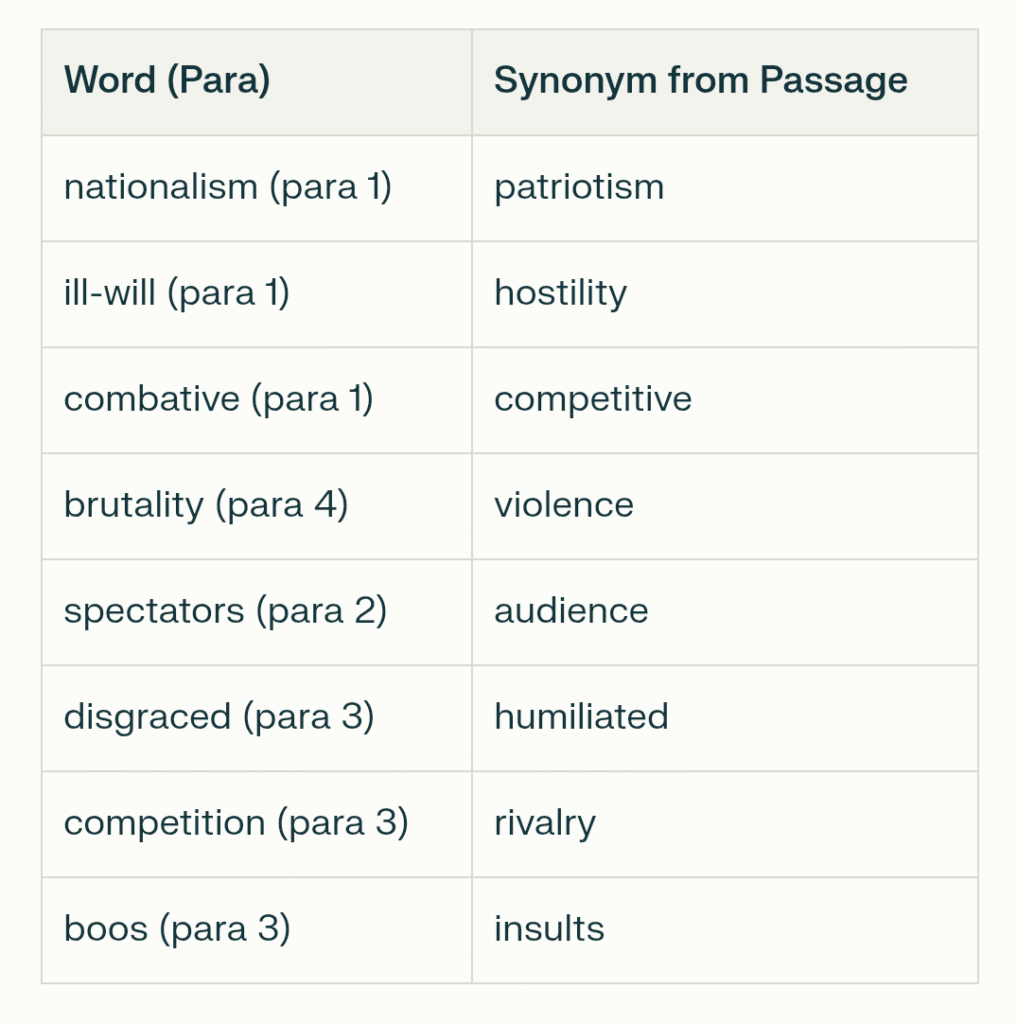
    Words Question B page 79

    Grammar – Joining Words (Linkers)

    Fill in the blanks in the passage with the given linkers:

    The Olympic Games are one of the most prestigious sporting events in the world. They bring together athletes from all nations, competing for glory. On the one side, they promote unity and sportsmanship, because the focus is not only on winning but also on participation. The Olympics are held every four years, with the result athletes spend years preparing for this moment. This the event is seen as a global celebration of human potential. On the other side, there are challenges, such as the financial burden it places on host cities and controversies surrounding doping. Nevertheless, the Olympic spirit continues to inspire people around the world.

    A Survey Report on the Attitude of School Children Towards Cricket Matches between India and Pakistan

    Objective:
    The objective of the survey was to find out the attitude of Indian school children towards sports competitions between India and Pakistan.

    The Survey:
    A total of 20 students were orally interviewed on August 23, 2025.

    All of them were asked to answer the following question by choosing only one of the three alternatives provided:

    Which country would you like to see win in a Cricket Test match between India and Pakistan?

    1. Pakistan
    2. India
    3. The better team

    Survey Results (Sample Data)

    1. No. of children interviewed: 20
    2. No. of children in favour of Pakistan: 2 (10% of the total)
    3. No. of children in favour of India: 14 (70% of the total)
    4. No. of children in favour of the better team: 4 (20% of the total)

    Discussion and Conclusion

    Most students preferred India to win, showing signs of patriotism. A few supported Pakistan, while a notable number wanted the better team to win, displaying a spirit of fairness and true sportsmanship.

    When these results are compared to George Orwell’s views in “The Sporting Spirit,” it is clear that national pride and rivalry are still powerful influences, which Orwell believed often lead to negative emotions. However, the presence of students who chose the better team suggests that fairness and sportsmanship are also valued by young people today.

  • Chapter- 5 A International Sports

    Skip to PDF content
    1. India, Pakistan, and Australia are taking part in this tournament.
    2. My mother bought vegetables, a pot of jam, a packet of biscuits, and some oranges from the market.
    3. Many people play games in order to develop the qualities of leadership, team spirit, cooperation, and cooperation in themselves.
    4. Wheat is grown in India in the states of Haryana, Punjab, Uttar Pradesh, and Andhra Pradesh.
    5. The batsman saw the ball, judged its line, moved forward, and smashed it to the boundary.

  • Class-7 Chapter-4B a great film maker Satyajit Ray

    Chapter: Great Film-maker Satyajit Ray

    Answer the following questions:

    1. Guess the language in which the first talking Indian film was made.
      The first talking Indian film, Alam Ara, was made in Hindi.
    2. Mention 4 interesting things about Satyajit Ray’s first film.
      • His first film was Pather Panchali (1955).
      • It was made on a part-time basis while Ray worked as a commercial artist.
      • The film was self-financed despite Ray having no previous experience in film-making.
      • It won a prize at the Cannes Film Festival and brought Indian cinema to global attention.
    3. What profession did Ray follow before he became a film-maker?
      He worked as a commercial artist from 1943 to 1956.
    4. Name the international awards Ray won for his films.
      • Pather Panchali – Prize at the Cannes Film Festival
      • Aparajito – Venice Golden Lion
      • Asani Sanket – Berlin Golden Bear Award
    5. Pick out some of the words/phrases used by Richard Attenborough in his tribute to refer to the greatness of Satyajit Ray as a film-maker.
      Rare genius, exquisite pieces of cinema, master, total revelation, enormous pleasure, an education, a major milestone.
    6. How did Richard Attenborough show his faith in Satyajit Ray as a film-maker when Ray asked him to act in his film The Chess Players?
      He accepted the offer without even reading the script, which he had never done before in his acting career.
    7. Richard Attenborough himself is a great film-maker. How is his manner of making films different from Ray’s?
      Attenborough relied on a team of experts for various aspects of film-making, while Ray handled almost everything himself – writing, directing, composing music, designing sets, and even operating the camera.
    8. Pick out some words/expressions used by Richard Attenborough showing his reaction to his experience of working with Ray.
      Enormous pleasure, an education, a major milestone, extremely content, revelation, unbounded energy, his sure touch.

    Words

    Match the types of films with their descriptions:

    Type of Film Description
    1. Feature film d. A long film/movie with a story
    2. Ad film f. A film made to tell people about a product or something they can buy
    3. Tele film a. A film that is specially made to be shown on television
    4. Animation film b. A film in which drawings of people and animals seem to move
    5. Documentary c. A film that gives facts about something
    6. Soap opera e. A story about the lives and problems of a group of people, shown on TV several times a week

    Chapter: Great Film-maker Satyajit Ray

    B. Fill in the blanks with appropriate words from the box:

    Word Bank: unbounded energy | expertise | tribute | exquisite | milestone | swan song

    1. The Taj Mahal is an exquisite piece of architecture.
    2. India has now enough scientific and technological expertise to build very good cars.
    3. Getting admission in a medical college will be a great milestone in my life.
    4. My mom works for 12–14 hours a day and does not get tired. She is a woman having unbounded energy.
    5. Hundreds of people had gathered to pay their last tribute to the heroes who had lost their lives in the war.
    6. This great painting was his swan song. He died the day after he had completed it.

    Writing

    Farewell Speech for a Retiring Teacher

    Respected Principal, dear teachers, and my fellow students,
    Today, we gather to bid farewell to one of the most respected and beloved teachers of our school, Mr./Ms. [Teacher’s Name]. It is difficult to say goodbye to someone who has been an inspiration to us all.
    Mr./Ms. [Teacher’s Name] has served our school for over [number] years with full dedication and love. As a teacher, [he/she] has always been kind, patient, and deeply committed to the learning of each student. Whether inside the classroom or in the corridors, [he/she] has always greeted everyone with a smile.
    Not only was [he/she] an excellent teacher in [subject], but also a mentor, a guide, and a true friend to many students. [He/She] always listened with empathy and offered advice with wisdom. Students respected [him/her], and teachers admired [his/her] honesty and discipline.
    The school will definitely miss your warm presence, your wise words, and your loving nature. We wish you all the best for the next chapter of your life. May it be filled with peace, happiness, and good health.
    Thank you for everything. You will always remain in our hearts.

    Follow-up

    A. Meanings of film-related expressions:

    • Feature film: A full-length film, usually with a story, meant for cinema release.
    • Tele film: A movie made specifically for television broadcast.
    • Documentary: A non-fiction film presenting facts and real-life events.
    • Ad film: A short film made for advertising a product or service.
    • Animation film: A film in which drawings or computer-generated images are made to move.
    • TV serial: A continuing television show with episodes broadcast regularly, often weekly.

    B. Meanings of terms related to cinema:

    • Cinema: A place where films are shown to the public; also refers to the film industry as a whole.
    • 3-D cinema: A type of cinema experience where films are shown in three dimensions using special glasses.
    • Cinemascope: A wide-screen format used in movies to create a panoramic visual effect.
    • Multiplex: A large cinema complex with multiple screens, showing several films at the same time.
  • Class-7 Chapter- 4A Cinema

    Cinema Chapter Answers

    Chapter: Cinema – Exercise Answers

    Answer the following questions:

    1. In paragraph 1, the writer calls film-making a very complicated industry because:
      • It involves hundreds or even thousands of people.
      • It can take over a year to complete one film.
      • Large sums of money are involved.
      • It requires many skilled technicians besides actors and actresses.
    2. The work of a director is to guide the actors on how to act each scene. He interprets the script and transforms it into a series of realistic and engaging scenes.
    3. The trick used is called back-projection, where pre-recorded background footage is projected behind the actors while filming in a studio.
    4. Shooting in a studio takes place in a controlled environment with artificial backgrounds and lighting, while shooting ‘on location’ means filming scenes at the actual place where the story is set.
    5. It would be expensive to shoot a whole scene on location because it requires transporting the entire cast, director, technicians, and equipment to a distant place, which adds to the cost.
    6. The film editor is responsible for arranging all the separate scenes in the correct order for the final version of the film.
    7. It is wrong because Picasso’s art belongs to the 20th century, whereas an eighteenth-century setting would require art and objects from that time period.
    8. The art director is in charge of designing and arranging the scenery and furniture in the film. They must ensure historical accuracy, especially in period films, so that no modern objects appear in scenes set in the past.
    9. Flowchart for making a film:
      1. First, a story is selected.
      2. A shooting script is prepared.
      3. A producer and director are appointed.
      4. Actors and actresses are selected.
      5. Scenes are shot on location or in studio.
      6. The film is edited and checked.
      7. The background music and sound effects are created.
      8. Finally, the sound is added to the appropriate scene.
    10. A scene often needs to be shot again and again to meet the director’s expectations and ensure it appears natural and convincing on screen.
    11. (a) ‘Appearances are deceptive.’ – A scene might look like it was shot on a real South Sea island, but it was actually filmed using back-projection in a studio.
      (b) ‘Nothing is real what it seems in the film world.’ – A ship in a storm is often just a small model in a water tank.

    Words

    A. Tree Diagram – The Film World

    Persons:

    • 1. Hero
    • 2. Art director
    • 3. Director
    • 4. Producer
    • 5. Cameraman
    • 6. Film editor
    • 7. Music director
    • 8. Actors/Actresses

    Things:

    • a. Story
    • b. On location
    • c. Shot
    • d. Script
    • e. Sound
    • f. Furniture/Scenery
    • g. Costumes/Wardrobe
    • h. Camera/Lighting

    B. Dictionary Word Sense

    The expression “indescribable confusion” in paragraph 6 uses the second meaning from the dictionary entry:

    2. disorder: Her unexpected arrival threw us into total confusion.
    Cinema – Grammar and Writing

    Grammar

    Read the following sentences:

    1. Do you ever think how films are made?
    2. It may be specially written for the film.

    Ever is an adverb of frequency. Adverbs of frequency tell us how often something is done.
    Specially is an adverb of manner. Adverbs of manner tell us how something happens or is done.

    Some more adverbs found in paragraphs 3–7 of the passage:

    Adverbs of Frequency:

    • usually
    • never
    • often

    Adverbs of Manner:

    • carefully
    • heavily
    • particularly
    • amazingly

    Writing

    Describe the process of film-making:

    First of all, a story is selected. It may be based on a novel, a play, or written especially for the film. Then a shooting script is prepared that includes all scenes, dialogue, and camera angles. A producer and director are appointed. The producer selects the cast and makes all arrangements. The director guides the actors and controls the artistic presentation of the film.

    Scenes are either shot on location or in the studio. When a location is too far, background footage is recorded earlier and used for back-projection. The actors perform in front of a screen showing this footage. Once all scenes are filmed, the editor joins the scenes in the correct order. If any scene is not satisfactory, it is retaken.

    The music director adds background music and sound effects. The art director arranges the set and ensures historical accuracy if needed. The wardrobe in-charge prepares costumes suitable for the film’s period. Finally, the sound is added and synchronized with the scenes.

    This is how a film is made before it reaches the cinema screen for audiences to enjoy.

    Talking About a Favourite TV Show

    Talking About a Favourite TV Show

    Rashid: Do you like TV programmes?

    Sanjeev: Not very much. Do you?

    Rashid: Yes, I love watching TV.

    Sanjeev: Which programmes do you watch the most?

    Rashid: I like them — especially game shows.

    Sanjeev: Why do you like them?

    Rashid: They’re so exciting.

    Sanjeev: Which is your favourite show?

    Rashid: ‘Kaun Banega Crorepati’. How about you? Do you like game shows?

    Sanjeev: No, I don’t. I can’t stand them.

    Rashid: I can’t believe it! What kind of shows do you enjoy, then?

    Sanjeev: I prefer science documentaries. I find them fascinating.

    Rashid: Really? I think they’re a bit boring.

    Sanjeev: Well, everyone has different tastes. Have you ever tried watching them?

    Rashid: Not really, but maybe I’ll give them a try.