
Understanding
1. Who do you think the man Pip meets in the churchyard could be? What specific word or description is used to refer to him?
The man Pip meets in the churchyard is a convict (a person who has escaped from prison). In the story, he is described as “a fearful man, all in coarse gray, with a great iron on his leg.” The word “convict” is not directly used by Pip, but this description makes it clear.
2. Identify the words or phrases that Pip uses to describe his parents. How does he come to think that they had these particular qualities?
Pip never saw his parents. He guesses what they looked like from the writings on their tombstones. For example, he thinks his father was “a square, stout, dark man, with curly black hair” because of the shape of the letters on his gravestone. He believes his mother was “freckled and sickly” because of the “character and turn of the inscription” on her tombstone.
3. What expression or phrase in the text suggests that Pip’s five brothers passed away at a very young age?
The phrase “five little stone lozenges…sacred to the memory of five little brothers of mine—who gave up trying to get a living exceedingly early in that universal struggle” suggests his brothers died very young.
4. Find the words in the second paragraph that depict the churchyard, the marshes, the river, and the sea.
- Churchyard: “this bleak place overgrown with nettles was the churchyard”
- Marshes: “the dark flat wilderness beyond the churchyard, intersected with dykes and mounds and gates, with scattered cattle feeding on it, was the marshes”
- River: “the low leaden line beyond was the river”
- Sea: “the distant savage lair from which the wind was rushing, was the sea”
5. At what location and time of day does Pip’s meeting with the convict take place?
Pip meets the convict in the churchyard, which is next to his parents’ graves, on a raw afternoon towards evening.
6. List the convict’s words and actions that create fear in Pip.
- He shouts at Pip: “Hold your noise!” and threatens, “I’ll cut your throat!”
- He grabs Pip by the chin and turns him upside down.
- He eats Pip’s bread “ravenously.”
- He grabs Pip and tilts him back to scare him.
- He threatens, “Or I’ll have your heart and liver out.”
- He warns Pip not to tell anyone, or else he and another “young man” will find him.
7. Why do you think the convict repeatedly glances at his leg and at Pip when he hears that Pip’s sister is married to a blacksmith?
He glances at his leg because it has an iron shackle on it—he is an escaped prisoner. When he hears Pip’s sister is married to a blacksmith (someone who can work with metal), he may worry Pip’s family could help catch him or remove the shackle.
8. Why do you think the convict is asking for a file? What do you think he plans to do with it?
The convict needs the file to cut through the iron shackle on his leg so he can escape more easily.
9. When the convict threatens Pip with dire consequences, what do these threats reveal about his personality or state of mind?
His threats show he is desperate, frightened, and maybe very angry. He is doing whatever he can to make sure Pip obeys, even saying scary things to keep himself safe from being caught.
10. What makes the convict say, ‘I wish I was a frog, or an eel?’
He says that because he is outside in the cold, wet marsh, wishing he could live in or handle the harsh, muddy, and wet conditions as easily as a frog or an eel can.
11. Why do you think the convict warns Pip not to mention him to anyone?
He warns Pip so that Pip doesn’t tell others and the convict won’t get caught by the police or townspeople. The warning is to keep himself safe.
A. Make a list of compound words that appear in the story.
Here are some compound words you can find in the story “Pip Meets the Convict”:
- tombstone
- blacksmith
- churchyard
- weathercock
- tombstone
- footstep
- gravestone
- heartless (if used in extended text)
- inside (sometimes written as one word)
B. Make compound words by combining the following words:
Let’s try making some compound words by putting two from your list together. Here are some examples:
- bed + room = bedroom
- foot + ball = football
- tail + bone = tailbone
- card + board = cardboard
- door + bell = doorbell
- fire + place = fireplace
- air + port = airport
- eye + brow = eyebrow
- book + mark = bookmark
- sun + light = sunlight
- mat + card = matcard
- rain + coat = raincoat
- day + light = daylight
- book + fair = bookfair
- time + table = timetable
- finger + print = fingerprint
- land + mark = landmark
- foot + step = footstep
Question – C Page- 135
State which of the following sentences are incorrect:
1. On every Saturday, after the cricket match, Raju would often come home completely exhausted.
- CORRECT.
You can use “would often” to describe a repeated past action.
2. She used to like him… Yes, but now she dislikes him!
- CORRECT.
“Used to” here tells us about a past state/habit that has changed.
3. She would live in Spain before the war, and then she moved to London.
- INCORRECT.
We can’t use “would” to talk about a single past state. Instead, use “used to”: - Correct version: “She used to live in Spain before the war, and then she moved to London.”
4. I remember we would go fishing every morning when I was a child. It was great. Now, I work as an accountant and don’t have any free time.
- CORRECT.
“Would go fishing” shows a repeated habit in the past.
5. The children would often help me bake a cake. They still do sometimes.
- CORRECT.
“Would often help” is fine for a repeated past action, and it makes sense with “They still do sometimes.”
6. She would be a great dancer until she injured her right foot.
- INCORRECT.
This is about a state/ability, not a repeated action. Use “used to”: - Correct version: “She used to be a great dancer until she injured her right foot.”
7. My uncle would always look happy before he lost his property five years ago.
- CORRECT.
“Would always look happy” is a repeated/regular past condition.
8. He would never punish anyone himself; he always had someone else do it for him.
- CORRECT.
This describes a habitual or repeated action in the past.
Summary – Incorrect Sentences are:
- 3. She would live in Spain before the war, and then she moved to London.
- 6. She would be a great dancer until she injured her right foot.
Writing
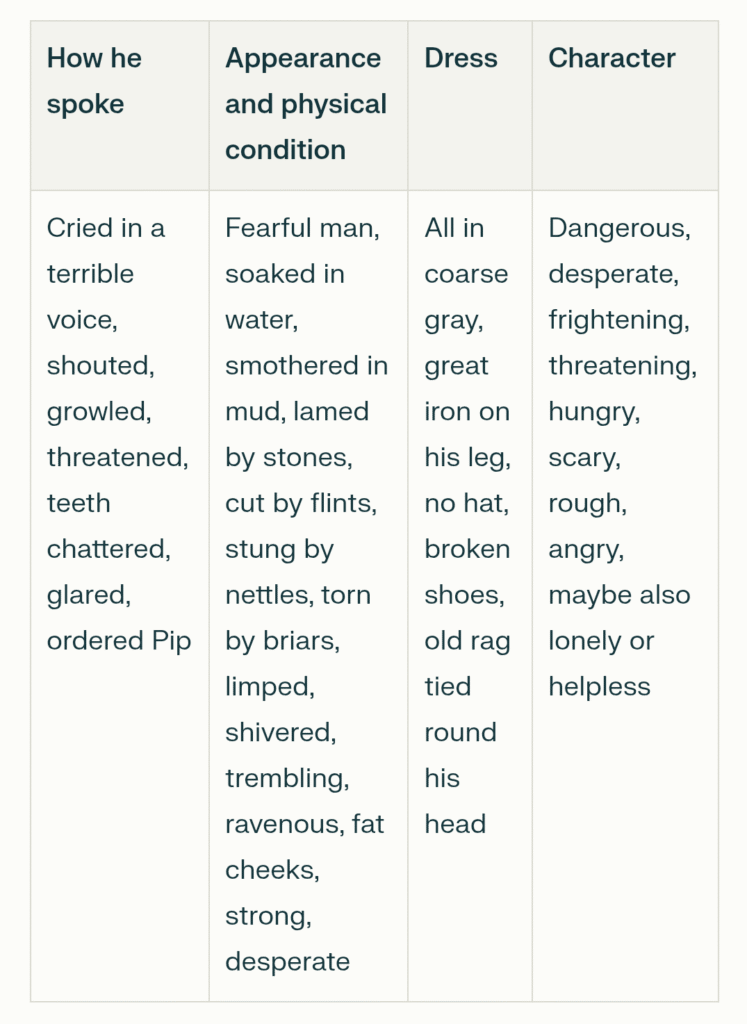
Here’s a short character sketch of the Convict using words and expressions discussed earlier:
Character Sketch of the Convict
The convict is a fearful and desperate man who seems very rough and dangerous at first. He appears soaked in water, smothered in mud, lamed by stones, and torn by briars, which shows that he has been through a lot of suffering. He wears coarse gray clothes, has a great iron on his leg, no hat, broken shoes, and an old rag tied around his head—all of which make him look poor and miserable.
The convict’s actions and words are frightening: he shouts, threatens, grabs Pip, and glares with chattering teeth. He scares Pip by threatening to cut his throat and saying he would take out his heart and liver if Pip didn’t help him. All these actions reveal that the convict is very desperate to survive and escape. Deep inside, he seems sad, lonely, and in great trouble, which makes him act rough and scary.
Though the convict frightens Pip, his hunger and tiredness also show he is just a man in need—the iron on his leg and his appearance suggest he is an escaped prisoner running from the law, not by choice, but by force of hard circumstances.