Category: Class-7 English Literature

  • Chapter – 12 The King and the Tree- Goddess

    Understanding

    1. In what ways was the King’s palace going to be different from any other palace in the Himalayan foothills?
      The King’s palace was going to be unique because it would be supported by only one column made from the tallest tree in the kingdom, instead of many columns or walls like other palaces.
    2. Which were the tallest and strongest trees in the Himalayas?
      The tallest and strongest trees in the Himalayas were the deodars.
    3. Who objected to the King’s plan to build the palace on the Deodar tree? And why?
      The King’s daughter objected to his plan because the deodar is a sacred tree and is usually only used for building temples.
    4. Why did the King at last decide to have a Deodar tree from his own park?
      The King decided to use a deodar tree from his own park because it was too difficult to bring a tree from the forest—all the efforts with men, horses, oxen, and elephants failed.
    5. What did the worshippers of the Deodar tree do when they learnt about the King’s plan to pull it down?
      The worshippers came with garlands, lamps, and music to show respect to the Tree-Goddess and to tell her that her tree would be cut down.
    6. Why did the King begin to call the Deodar tree as ‘Tree-Goddess’? Make a list of all those who benefited from the Deodar tree.
      The King called the deodar tree ‘Tree-Goddess’ because people believed a goddess lived in the tree, which gave the tree its strength, size, and beauty.
      Those who benefited from the tree were:
      • Birds (they nested in the tree)
      • People (rested in its shade)
      • Wild animals (rubbed against it)
      • The earth (new plants grew under it)
      • Children (played at its foot)
      • Women (rested after working in the fields)
    7. What request did the Goddess of Deodar tree make to the King? And why?
      The Tree-Goddess requested the King to cut the tree in three parts instead of one, so that the young deodar trees around her would not be crushed if the big tree fell all at once.
    8. Why did the King decide to build his palace on a column of stone, and not of wood from the Deodar tree? What other things did he add to the palace?
      The King changed his mind after the vision with the Tree-Goddess. He realized the spirit in the deodar tree was nobler than his own, so he decided to use stone instead of wood. He also created a beautiful park around his palace for everyone to enjoy.

    Words: Choose the correct meaning

    1. My home shall be as magnificent as any temple!
      b. grand
    2. Animals were brought from the plains, but the hills were too steep for them.
      a. high
    3. After much searching, the King’s men found a splendid deodar tree not far from the city.
      a. excellent
    4. They came…to warn her that she must leave her abode.
      b. home
    1. And he shared his vision, and they all marvelled.
      a. surprised
    2. Let me be cut in three parts.
      d. separated
    3. …my weight will crush all of them.
      d. destroy
    4. …the children from nearby villages flocked to the field to sit on the grass.
      b. ran together

    Grammar


    2. “But the deodar is a sacred tree,” his daughter objected. “It is used in the construction of temples.”

    Reported Speech:
    His daughter objected that the deodar was a sacred tree and said that it was used in the construction of temples.


    3. “That’s exactly why I want one,” replied the King. “My palace should be as grand as any temple.”

    Reported Speech:
    The King replied that this was exactly why he wanted one and added that his palace should be as grand as any temple.


    4. “No, my decision is final,” said the King in his vision. “Your tree is the only one in all my lands strong enough to bear the weight of my palace, so I must have it.”

    Reported Speech:
    The King said in his vision that his decision was final and explained that the tree was the only one in all his lands strong enough to bear the weight of his palace, so he had to have it.


    5. “But think carefully, O King! For centuries, I have been revered by the people of all the nearby villages, and only good has come from me to them.”

    Reported Speech:
    The Tree-Goddess asked the King to think carefully and told him that for centuries she had been revered by the people of all the nearby villages, and only good had come from her to them.
  • Chapter-11 The Spider and the Fly


    Understanding

    1. List of things the spider offers to the fly if she visits his parlour:
      • To show her many curious things.
      • To let her rest on his comfortable bed with fine sheets and pretty curtains.
      • To give her nice things to eat from his pantry.
      • To let her look at herself in his little looking-glass (mirror).
    2. Features of his parlour the spider tells the fly about:
      • It’s the prettiest little parlour; the way is up a winding stair.
      • There are many curious things to see there.
    3. Words/expressions used to flatter the fly (Stanza 4):
      • “Sweet creature”
      • “You’re witty and you’re wise”
      • “How handsome are your gauzy wings”
      • “How brilliant are your eyes”
    4. Why did the spider think the fly would come again?
      • The spider knew the fly was silly and would be tempted by his flattery and offers.
    5. What did the spider do to trap the fly?
      • He weaved a subtle web in a corner, set his table to dine, and waited for the fly to return.
    6. What did the spider plan to do once the fly was caught?
      • The spider planned to eat the fly.
    7. What made the fly fall into the spider’s trap at last?
      • The fly was fooled by the spider’s flattering words and forgot the warnings.
    8. Words or expressions that show how the spider caught the fly:
      • “Up jumped the cunning spider, and fiercely held her fast”
      • “He dragged her up his winding stair, into the dismal den”
    9. Advice the poet gives to the reader:
      • Never trust or listen to silly, flattering words, and always ignore bad advice.
    10. Rhyming words in the poem:
      • fly/spy, stair/there, vain/again, thin/in, do/you, wise/eyes, shelf/self, den/again, sing/wing, head/lead, by/hue, fast/last, den/again, read/heed, eye/fly.

    Words (from the poem):

    • without success (stanza 1): in vain
    • tired (stanza 2): weary
    • see (stanza 3): behold
    • clothes (stanza 5): robes
    • strongly (stanza 6): fiercely
    • attention (stanza 7): heed

  • Chapter – 10 My Financial Career


    1. How did the author look whenever he went to the bank? Pick out the word/phrase that conveys this.

    The author looked very nervous and anxious whenever he went to the bank. The words that describe this are “rattled” and “shambled in and looked timidly round at the clerks.”


    2. What change took place in the author when he was face to face with the accountant?

    When he was face to face with the accountant, the author became even more nervous and started talking in a gloomy, serious way. He couldn’t speak confidently and his voice was described as “sepulchral.”


    3. Why did the author want to meet the manager ‘alone’? How did the manager feel about it?

    The author wanted to meet the manager ‘alone’ because he thought it was the proper thing to do when opening an account, but he didn’t really have a special reason. The manager felt a bit alarmed and thought the author might have an “awful secret.”


    4. What was the first impression that the manager had about the author? Give reasons for your answer.

    The manager’s first impression was that the author was someone important, maybe a detective or a rich person. This is because the author acted very mysterious and asked to meet the manager alone, which made him suspicious.


    5. What actions/words of the writer made the manager think that the writer was a very rich person and belonged to a family of bankers?

    The author’s secretive way of talking, his wanting to meet the manager alone, and his statement, “I intend to keep all my money in this bank,” made the manager think he was a rich person from a family of bankers.


    6. What change do you notice in the manager when he discovered that the writer was an ordinary client?

    Once the manager realized that the author only wanted to deposit fifty-six dollars, he stopped being serious and important and spoke to the accountant in a loud, unkind way. He understood that the author was just a regular customer.


    7. Why did the author’s face look ‘ghastly pale’ after he quickly handed over the money to the accountant?

    The author’s face looked “ghastly pale” because he was extremely nervous and embarrassed while handing over the money, worried about making a mistake.


    8. Why do you think did the author write ‘fifty-six’ instead of ‘six dollars’ on the cheque?

    The author wrote ‘fifty-six’ instead of ‘six dollars’ on the cheque because he was so nervous and confused that he made a mistake.


    9. How did the clerk in the bank look when he saw the author withdrawing the entire money soon after he had deposited it?

    The clerk looked very surprised when he saw the author withdrawing all the money right after depositing it. He even asked, “What! Are you drawing it all out again?”


    10. What impression did the people in the bank form of the author? How did they express it when he left the bank?

    The people in the bank thought the author was strange and maybe even a little foolish. When he left, they all laughed loudly, showing they found his behavior weird and funny.


    11. What sort of person is the writer? Support your answer by citing examples from the story.

    The writer is a very nervous, shy, and awkward person, especially in banks. For example, he felt rattled by everything in the bank and made silly mistakes like depositing all his money and then immediately taking it all out.


    12. Why does the author give this story the title ‘My Financial Career’? Do you find it an appropriate title? Give reasons for your answer. Can you think of another suitable title for this story?

    The author calls it “My Financial Career” in a funny way because his experience with the bank is so awkward that it seems like a whole ‘career’ for him, even though it’s just one visit. Yes, it’s an appropriate title because it matches the humor in the story. Another suitable title could be “My Adventure at the Bank” or “A Day at the Bank”.


    B. True or False? Correct the false statements.

    1. The author really wanted to see the manager alone.
      False. The author did not actually want to see the manager alone; he just thought it was something he should do.
    2. The author thought that fifty-six dollars was a large sum of money.
      True.
    3. The author found the business of depositing and withdrawing money from a bank a very complicated thing.
      True.
    4. The author wrote fifty-six dollars instead of six out of nervousness.
      True.
    5. The bank manager was very pleased when the author said that he wanted to deposit fifty-six dollars.
      False. The bank manager was not pleased; when he found out it was only fifty-six dollars, he was disappointed.
    6. The author is trying to make fun of the banking system and the bank staff.
      True.

    Words

    A. Fill in the blanks with suitable words from the passage.

    A bank is a place where people put their money because it is safe. On its staff, a bank may have a manager, an accountant and some clerks.
    To put money in a bank you must first open an account, after which the bank will issue you a cheque book.
    Once an account has been opened, you can deposit your salary every month in the bank and then withdraw it as and when you need it.
    In order to withdraw money from the bank you must first write a cheque and hand it over to the clerk at the window, who will then pay you the money.


    B. Pick out other words/expressions in the story that describe different feelings and attitudes.

    Some words/expressions from the story that show different feelings and attitudes are:

    • “rattled”
    • “timidly round”
    • “shambled in”
    • “my voice was sepulchral”
    • “ghastly pale”
    • “reckless with misery”
    • “wretched”
    • “in a hallow vibrating voice”

    All of these phrases show how nervous, scared, or embarrassed the author felt in the bank!

    Grammar

    (a) Reported speech version:

    Tom asked Maggie if he hadn’t been a good brother.
    Maggie replied that he had been very, very good and said that she loved him.
    Tom then said that he must go and see his rabbits.
    Maggie began to tremble with fear as she followed Tom.
    She asked Tom how much money he had given for his rabbits.
    Tom replied promptly that he had given five shillings and six pence.
    He added that he thought he had more than that upstairs, and told her to take all that money and buy some more rabbits.


    (b) Reported speech version:

    Tom’s father asked where his little girl was.
    Tom replied that he didn’t know and that he hadn’t seen her for two hours.
    Tom’s mother suggested that perhaps she was up there under the roof.
    Tom’s father then ordered Tom sharply to go and fetch her down.

    Pg. 114 Writing


    Something very funny happened today. I was sitting in my room when the accountant, Mr. Montgomery, came to me. He said that a very serious-looking man wanted to see me alone. I got up and invited the man into my office.

    As soon as he entered, I noticed he looked quite nervous. He clutched some money in his hand and kept asking if we were “safe from interruption.” I thought he might have some important secret or maybe be someone very rich! But, to my surprise, he just wanted to open a small bank account.

    He spoke in such a weird and mysterious way that for a moment I wondered if he was a detective or even a millionaire. But then he told me he wanted to deposit only fifty-six dollars! After we helped him fill out the forms, he got even more confused and asked right away to withdraw money. But by mistake, he wrote a cheque for all his money instead of just six dollars!

    All the clerks and I couldn’t stop laughing after he left. It was such a funny moment, and definitely the strangest account opening I’ve ever seen as a bank manager!

  • Chapter – 9 Alone

    Understanding

    1. Which aspect of old age is conveyed in stanza 1?
    Stanza 1 shows that old age can be lonely. The old woman lives alone, and all she hears are the sounds of a cricket and a mouse.

    2. Which stage of life is suggested in stanzas 2 and 3?
    These stanzas talk about the woman’s childhood and youth. She used to play, dance, run to her mother, and enjoy music and singing.

    3. Which line in stanza 4 suggests that everyone gets old?
    The line “But age apace / Comes at last to all;” suggests that everyone grows old eventually.

    4. Which part of the day is suggested by the expression ‘dusk of day’?
    “Dusk of day” means evening, the time just before night falls.

    5. Pick out the rhyming words from the poem.
    Here are some rhyming pairs from the poem:

    • house/mouse
    • play/popinjay/day
    • in/chin/wren
    • all/call/wall

    6. What is an old person’s company in the end?
    In the end, the old woman is only left with the sounds of the cricket and the mouse for company.

    7. What is being compared in the last two lines of stanza 3?
    The sound of the woman’s singing is being compared to the soft, gentle twittering of a small wren (a kind of bird).


    Follow-up

    Do old grandparents in your home feel as lonely as the old woman mentioned in the poem? Give at least three reasons for your answer.

    Sample Answer:
    No, my grandparents do not feel as lonely as the old woman in the poem. Here are three reasons why:

    1. Family Time: We spend time with our grandparents every day. We talk to them, share meals, and celebrate festivals together, so they feel included and loved.
    2. Activities and Hobbies: My grandparents enjoy doing activities like gardening, reading, and watching TV with us, which keeps them happy and busy.
    3. Care and Support: Whenever they need anything, someone in the family is always there to help. They don’t have to depend only on the sounds of the house like the woman in the poem.

    If someone’s grandparents do feel lonely, maybe because everyone is busy or they live alone, it’s important to spend more time with them, talk to them, and include them in family activities. This will make them feel happier and less lonely.

  • Chapter – 8 Doing What You Like Is Freedom


    Understanding

    A. Answer the following questions.

    1. Where were the Raos travelling to and why?
      The Raos were travelling to Belgaum because their son Puneet got admission to the Belgaum Medical College.
    2. Pick out words/expressions that show that Puneet did not like the instructions his parents were giving him.
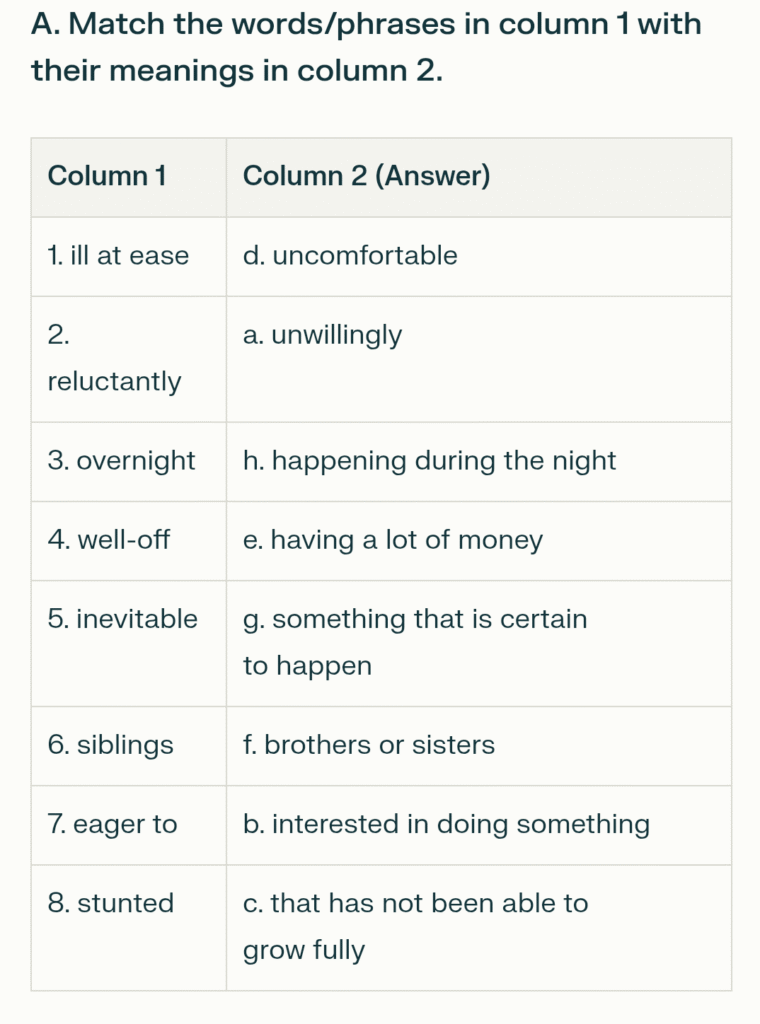
      Expressions like “The young boy seemed uncomfortable with all the attention, especially in front of a stranger, but he reluctantly obeyed and answered them” show that Puneet did not like the instructions his parents were giving him.
    3. Pick out whatever bits of information you can from the story to show that the Raos were ‘well-off’. One of them is: They normally travelled by air or by IInd AC.
      • They normally travelled by air or II AC.
      • The family had a huge tiffin carrier with an elaborate meal, table mats, steel plates, and even a dessert for train travel.
      • The mother was ready to rent a house in Belgaum for five years for Puneet’s comfort.
      • They lived in Bangalore and owned land in Tumkur district.
      • The father is a CA (Chartered Accountant) and the mother has an MA.
    4. In the beginning, the Raos were not very keen to talk to the writer, who was travelling in the same compartment as they. But later they were eager to talk to her. Why?
      Initially, they were reserved because she was a stranger. When they found out the writer belonged to Belgaum and knew about the college and town, they became eager to talk to her as they wanted more information helpful for Puneet.
    5. The writer says, ‘It is difficult time for parents, but it is also inevitable. How long can you keep birds in cages when their wings are strong and they are ready to fly?’ What does she mean and why does she say all this?
      She means that although it is hard for parents to let their children go, children must eventually become independent and live their own lives. Parents cannot always keep children protected like birds in a cage because, at some point, children need to use their wings and fly on their own.
    6. ‘Our choice is his choice,’ says one of Puneet’s parents. What does it tell you about the parents’ attitude towards Puneet?
      It shows that Puneet’s parents believe they know what is best for him and make all the important decisions for him, without considering his likes or interests. They do not let him make his own choices.
    7. ‘The gentleman switched off the light without even waiting for any reply,’ says the writer. Why did the gentleman switch off the light? And what does it tell you about his attitude towards fellow passengers?
      He switched off the light because his son cannot sleep with the light on. He did not consider the comfort or needs of the other passengers, showing that he only cared about his own family’s comfort and not about others.
    8. ‘Puneet will never be a confident person,’ says the writer. Why does she say this?
      The writer says this because Puneet’s parents make all decisions for him, do not allow him independence, and overprotect him. As a result, he does not get opportunities to build confidence or solve his own problems.
    9. Who was the other boy the writer met in the train? What impression did the writer form of him when she saw him in the other compartment?
      The other boy was Sharad. The writer found him self-confident, friendly, energetic, willing to talk, and able to mix easily with people. He looked happy and independent, in contrast to Puneet.
    10. Sharad claims that he grew up like a tree in a forest, whereas the writer calls Puneet a stunted bonsai. A bonsai is a small tree grown in a pot and prevented from growing to its normal size. Discuss in your group the way the two boys have grown up. Which one, according to you, is the better way?
      Sharad grew up freely, learning many skills, mixing with others, and making his own decisions. Puneet grew up protected and controlled, with no real independence. Growing up like Sharad is better because it helps build confidence, skills, and the ability to face challenges.
    11. How does Sharad define freedom? What according to him are the limits beyond which freedom is not good?
      Sharad defines freedom as being able to choose your own life, pursue your interests, and enjoy what you like, as long as it is not harmful to yourself or to society. He believes that true freedom should never hurt you or others.

    B. Table: Similarities and Contrasts between Puneet and Sharad

    Similarities

    1. Both are medical students, going to Belgaum.
    2. Both are only children to their parents.
    3. Both have caring and loving parents.

    Contrasts

    1. Sharad travelling alone; Puneet accompanied by his parents.
    2. Sharad is self-confident and full of energy, and willing to talk; Puneet is shy, uncomfortable, and reserved.
    3. Sharad is an all-rounder, interested in music, sports, social activities, can swim, was in NCC; Puneet’s activities are mostly chosen by his parents, and he is not encouraged to try new things independently.
    4. For Puneet, all the decisions are taken by his parents; Sharad makes his own decisions.
    5. Both have working parents; but one of Puneet’s parents (his mother) left her job to take care of him.
    6. Sharad is from a village near Kolar; Puneet is from the city of Bangalore.
    7. Puneet’s parents are overprotective and controlling; whereas Sharad’s parents are supportive and give him freedom.
    8. Sharad has taken a loan to finance his studies; whereas Puneet’s studies are financed by his parents.
    9. Sharad has travelled alone many times; whereas Puneet has never travelled alone before.

    B. Using Over- and Under- as Prefixes

    Given words: paid | age | weight | crowded | joyed | sight | sea | populated | head | ground

    Over-:

    • overpaid
    • overweight
    • overcrowded
    • overjoyed
    • oversee
    • overpopulated
    • overhead

    Under-:

    • underpaid
    • underage
    • underweight
    • underground
    • underpopulated
    • undersea
    • underfed
    • underlined
    • undersight

    Grammar: Reported Speech

    Rewrite the conversation between Sharad and the writer in reported speech:

    Direct Speech:

    • ‘How did you do in your exam?’ I asked.
    • ‘I think I did fairly well. I got a seat in Belgaum Medical College,’ said Sharad.
    • ‘Is it not very expensive?’
    • ‘It is expensive. But I have taken a loan from a bank. I will replay the loan once I start working.’
    • ‘What is the most important thing for you in life?’
    • ‘It is freedom to choose one’s own life.’

    Reported Speech:

    I asked Sharad how he had done in his exam. Sharad replied that he thought he had done fairly well and that he had got a seat in Belgaum Medical College. I asked him if it was not very expensive. He answered that it was expensive but he had taken a loan from a bank and would repay the loan once he started working. I asked him what was the most important thing in his life. He replied that it was freedom to choose one’s own life.