Category: Uncategorized

  • 10/10/2026-Fiza

    MATHEMATICS · ADVANCED PRACTICE

    Fiza’s BODMAS Challenge

    20 Tough Simplification Questions

    StudentFiza
    Total Questions20
    Maximum Marks20

    Date: __________________

    Suggested time: 45–60 minutes

    Instructions: Solve each question step by step. Show all working and do not use a calculator.

    REMEMBER

    BODMAS Rule

    1. B — Brackets
    2. O — Orders, such as powers. No powers are used in this worksheet.
    3. D and M — Division and Multiplication, from left to right.
    4. A and S — Addition and Subtraction, from left to right.
    Important: Multiplication does not always come before division. When both appear together, calculate from left to right. Apply the same rule to addition and subtraction.
    LEVEL 1 · CHALLENGING

    Mixed Operations

    Apply the correct order of multiplication, division, addition and subtraction.

    184 ÷ 7 × 3 + 16 − 8
    2120 − 48 ÷ 6 × 4 + 9
    396 ÷ 8 × 5 − 18 + 7
    4150 − 72 ÷ 8 × 6 + 11
    LEVEL 2 · BRACKETS

    Brackets with Mixed Operations

    Solve the brackets first, then continue with the remaining operations.

    572 ÷ (9 − 3) × 4 + 5
    6100 − (24 ÷ 4 + 3) × 5
    7(36 + 24) ÷ 5 × 3 − 8
    8144 ÷ (6 × 4) + (25 − 9) × 2
    LEVEL 3 · NESTED BRACKETS

    Parentheses, Brackets and Braces

    Work from the innermost brackets outwards.

    980 − {12 + (18 ÷ 3) × 4}
    10120 ÷ {5 × (8 − 4)} + 17
    11150 − {24 ÷ (2 × 3) + 8 × 7}
    12{60 ÷ (5 + 5)} × [18 − (12 ÷ 3)]
    LEVEL 4 · ADVANCED

    Multi-Step Simplification

    Pay close attention to the order of operations in each expression.

    13200 − [48 ÷ (4 × 3)] × 15
    14180 ÷ [3 × (10 − 4)] + 7 × 5
    15250 − {6 × [24 ÷ (8 − 4)] + 35}
    16[96 ÷ (4 × 3) + 7] × 6 − 18
    LEVEL 5 · MASTER CHALLENGE

    Complex BODMAS Problems

    These questions require careful calculation at every stage.

    17300 − {8 × [36 ÷ (9 − 3)] + 24}
    18240 ÷ {4 × [15 − (12 ÷ 3)]} + 19
    19400 − [120 ÷ {5 × (8 − 2)}] × 30
    20{180 ÷ [3 × (14 − 8)]} × [25 − (18 ÷ 3)] + 12
    SELF-ASSESSMENT

    Check Your Work

    □ I solved the innermost brackets first.

    □ I followed left-to-right order for division and multiplication.

    □ I followed left-to-right order for addition and subtraction.

    □ I showed all intermediate steps.

    Score: ______ / 20

    Questions to practise again: __________________________

    Teacher’s Answer Key — Click to Reveal
    1. 44
    2. 97
    3. 49
    4. 107
    5. 53
    6. 55
    7. 28
    8. 36
    9. 44
    10. 23
    11. 91
    12. 84
    13. 140
    14. 45
    15. 179
    16. 72
    17. 228
    18. 23
    19. 280
    20. 107

    Teacher’s Assessment Guide

    16–20 marks: Strong understanding. Introduce more complex expressions.

    12–15 marks: Revise the incorrect questions and practise similar ones.

    Below 12 marks: Revisit operation priority and nested brackets before progressing.

  • 09/10/2026-Fiza

    MATHEMATICS · PRACTICE WORKSHEET

    Simplification & BODMAS

    Build your skills step by step, from basic to advanced.

    StudentFiza
    Total Questions25
    Maximum Marks25

    Date: __________________

    Instructions: Solve every question step by step. Show your working and do not use a calculator.

    BODMAS Rule

    1. B — Brackets
    2. O — Orders (powers, such as 3²)
    3. D and M — Division and Multiplication, from left to right
    4. A and S — Addition and Subtraction, from left to right
    Important: Multiplication does not always come before division. When both appear together, solve from left to right. The same rule applies to addition and subtraction.

    Four Operations

    Practise the correct order of multiplication, division, addition and subtraction.

    18 + 4 × 2
    218 − 12 ÷ 3
    36 × 3 + 5
    430 ÷ 5 + 7
    524 − 4 × 3 + 2

    Expressions with Brackets

    Always simplify the brackets first.

    6(8 + 4) × 2
    720 − (6 + 4)
    836 ÷ (3 × 4)
    95 × (7 − 3) + 6
    1040 ÷ (8 − 3) + 4

    Mixed Operations

    Pay attention to left-to-right order when operations have equal priority.

    1148 ÷ 6 × 2 + 5
    1225 − 12 ÷ 3 × 2
    137 + 18 ÷ 3 − 2
    1460 ÷ 5 + 4 × 3 − 6
    158 × 4 ÷ 2 + 9 − 5

    Powers and Nested Brackets

    Simplify the innermost brackets first, then follow BODMAS.

    163² + 4 × 5
    172 × (6 + 3)² ÷ 9
    1850 − {12 + (8 ÷ 2) × 3}
    1972 ÷ [3 × (8 − 4)] + 5
    20100 − {24 ÷ (2 × 3) + 7 × 4}

    Advanced Simplification

    Read each expression carefully and write every intermediate step.

    21120 ÷ [5 × (6 − 2)] + 3²
    2280 − {6 × (9 − 4) + 18 ÷ 3}
    23[36 ÷ (3 × 2) + 4] × 3
    24150 ÷ {5 × [2 + (8 ÷ 4)]} + 7
    25200 − {4² × 3 + [48 ÷ (4 × 2)] × 5}

    Check Your Understanding

    Tick each statement after completing the worksheet.

    □ I can follow BODMAS correctly.

    □ I can simplify brackets before other operations.

    □ I can solve division and multiplication from left to right.

    □ I can solve expressions involving powers.

    □ I can solve nested-bracket questions independently.

    My score: ______ / 25

    Topics I need to practise again:

    Teacher’s Answer Key — Click to Reveal

    Keep this section closed while Fiza is attempting the worksheet.

    1. 16
    2. 14
    3. 23
    4. 13
    5. 14
    6. 24
    7. 10
    8. 3
    9. 26
    10. 12
    11. 21
    12. 17
    13. 11
    14. 18
    15. 20
    16. 29
    17. 18
    18. 26
    19. 11
    20. 68
    21. 15
    22. 44
    23. 30
    24. 12
    25. 112
  • Ex. 8.2 Discount

    Class 8 Mathematics

    Exercise 8.2 — Comparing Quantities: Discount

    📘 Points to Remember

    1. Discount is always calculated on the Marked Price (M.P.).
    2. Selling Price:
    S.P. = M.P. − Discount
    3. Discount Percentage:
    Discount % = \[ \frac{\text{Discount}}{\text{M.P.}}\times100 \]
    4. Selling Price when discount is given:
    \[ S.P. = M.P.\times \frac{100-\text{Discount%}}{100} \]
    5. Marked Price:
    \[ M.P. = \frac{100\times S.P.} {100-\text{Discount%}} \]
    6. Successive Discounts:
    When two or more discounts are given one after another, they are called successive discounts or discounts in series.
    Question 1
    Find the selling price if:
    (a) M.P. = ₹1300 and Discount = 10%
    Discount = 10% of ₹1300
    \[ =\frac{10}{100}\times1300 \] \[ =₹130 \]
    Selling Price = Marked Price − Discount
    \[ =₹1300-₹130 \] \[ =₹1170 \]
    ✅ Answer: S.P. = ₹1170
    (b) M.P. = ₹4650 and Discount = 18%
    Discount = 18% of ₹4650
    \[ =\frac{18}{100}\times4650 \] \[ =₹837 \]
    Selling Price = ₹4650 − ₹837
    \[ =₹3813 \]
    ✅ Answer: S.P. = ₹3813
    Question 2
    Find the marked price if:
    (a) S.P. = ₹1222 and Discount = 6%
    After a 6% discount, the selling price is:
    \[ 100%-6%=94% \]
    Therefore,
    \[ 94%\text{ of M.P.}=₹1222 \] \[ M.P. = \frac{1222\times100}{94} \] \[ =₹1300 \]
    ✅ Answer: M.P. = ₹1300
    (b) S.P. = ₹540 and Discount = 10%
    After a 10% discount, the selling price is 90% of the marked price.
    \[ 90%\text{ of M.P.}=₹540 \] \[ M.P. = \frac{540\times100}{90} \] \[ =₹600 \]
    ✅ Answer: M.P. = ₹600
    Question 3
    Find discount in per cent, when:
    (a) M.P. = ₹900 and S.P. = ₹873
    Discount = M.P. − S.P.
    \[ =₹900-₹873 \] \[ =₹27 \]
    Discount percentage:
    \[ \text{Discount%} = \frac{27}{900}\times100 \] \[ =3% \]
    ✅ Answer: Discount = 3%
    (b) M.P. = ₹1000 and S.P. = ₹850
    Discount = ₹1000 − ₹850
    \[ =₹150 \]
    Therefore,
    \[ \text{Discount%} = \frac{150}{1000}\times100 \] \[ =15% \]
    ✅ Answer: Discount = 15%
    Question 4
    A shopkeeper offers 2.5% discount on cash purchases. What cash amount would Anju should pay for a cycle the marked price of which is ₹1300?
    Discount = 2.5% of ₹1300
    \[ =\frac{2.5}{100}\times1300 \] \[ =₹32.50 \]
    Therefore, cash amount to be paid:
    \[ S.P.=₹1300-₹32.50 \] \[ =₹1267.50 \]
    ✅ Answer: Anju should pay ₹1267.50.
    Question 5
    The marked price of a ceiling fan is ₹720. During off-season, it is sold for ₹684. Determine the discount per cent.
    Discount = M.P. − S.P.
    \[ =₹720-₹684 \] \[ =₹36 \]
    Discount percentage:
    \[ \text{Discount%} = \frac{36}{720}\times100 \] \[ =5% \]
    ✅ Answer: Discount = 5%
    Question 6
    Find the rate of discount being given on a shirt whose selling price is ₹546 after deducting a discount of ₹104 on its marked price.
    We know:
    \[ S.P.=M.P.-\text{Discount} \]
    Therefore,
    \[ M.P.=S.P.+\text{Discount} \] \[ =₹546+₹104 \] \[ =₹650 \]
    Now find the discount percentage:
    \[ \text{Discount%} = \frac{104}{650}\times100 \] \[ =16% \]
    ✅ Answer: Rate of discount = 16%
    Question 7
    The marked price of an article is ₹500. The shopkeeper gives a discount of 5% and still makes a profit of 25%. What is the cost price of the article?
    First, find the selling price.
    Discount = 5% of ₹500
    \[ =\frac{5}{100}\times500 =₹25 \]
    Therefore,
    \[ S.P.=₹500-₹25 \] \[ =₹475 \]
    The shopkeeper makes a profit of 25%. Therefore, S.P. = 125% of C.P.
    \[ C.P. = \frac{475\times100}{125} \] \[ =₹380 \]
    ✅ Answer: Cost Price = ₹380
    Question 8
    A dealer marks his goods at 35% above the cost price and allows a discount of 20% on the marked price. Find his gain or loss per cent.
    Let the cost price be ₹100.
    Marked price is 35% above the cost price:
    \[ M.P.=₹100+35%=₹135 \]
    Discount = 20% of ₹135
    \[ =\frac{20}{100}\times135 =₹27 \]
    Therefore, selling price:
    \[ S.P.=₹135-₹27 \] \[ =₹108 \]
    Cost price = ₹100 and selling price = ₹108.
    \[ \text{Gain}=₹108-₹100 =₹8 \] \[ \text{Gain%} = \frac{8}{100}\times100 =8% \]
    ✅ Answer: Gain = 8%
    Question 9
    A trader allows a discount of 15% on the written price. How much above the cost price must he mark his good to make a profit of 19%?
    Let the cost price be ₹100.
    To make a profit of 19%, the required selling price is:
    \[ S.P.=₹100+19% \] \[ =₹119 \]
    A discount of 15% is allowed on the marked price. Therefore, the selling price is 85% of the marked price.
    \[ 85%\text{ of M.P.}=₹119 \] \[ M.P. = \frac{119\times100}{85} \] \[ =₹140 \]
    Therefore, the marked price is ₹140 when the cost price is ₹100.
    \[ \text{Increase over C.P.} = ₹140-₹100 =₹40 \] \[ \text{Percentage increase} = \frac{40}{100}\times100 =40% \]
    ✅ Answer: He must mark the goods 40% above the cost price.
    Question 10
    A shopkeeper allows 23% commission on his advertised price and still makes a profit of 10%. If he gains ₹56 on one item, find his advertised price.
    Let the cost price be ₹x.
    Gain = ₹56 and gain = 10%.
    \[ 10%\text{ of C.P.}=₹56 \] \[ C.P. = \frac{56\times100}{10} \] \[ =₹560 \]
    Therefore, the selling price is:
    \[ S.P.=₹560+₹56 \] \[ =₹616 \]
    The shopkeeper allows 23% commission on the advertised price. Therefore, he receives 77% of the advertised price.
    \[ 100%-23%=77% \] \[ 77%\text{ of Advertised Price}=₹616 \] \[ \text{Advertised Price} = \frac{616\times100}{77} \] \[ =₹800 \]
    ✅ Answer: Advertised Price = ₹800

    📋 Quick Answer Check

    Question Answer
    1(a) ₹1170
    1(b) ₹3813
    2(a) ₹1300
    2(b) ₹600
    3(a) 3%
    3(b) 15%
    4 ₹1267.50
    5 5%
    6 16%
    7 ₹380
    8 Gain = 8%
    9 40% above C.P.
    10 ₹800
    🌟 Remember:
    Discount is always calculated on the Marked Price.
    So, whenever you see a discount question, remember:
    M.P. → Discount → S.P.
    Also remember that profit or loss is calculated on the Cost Price, not on the Marked Price.
  • Class 8th S.Sc. Answer

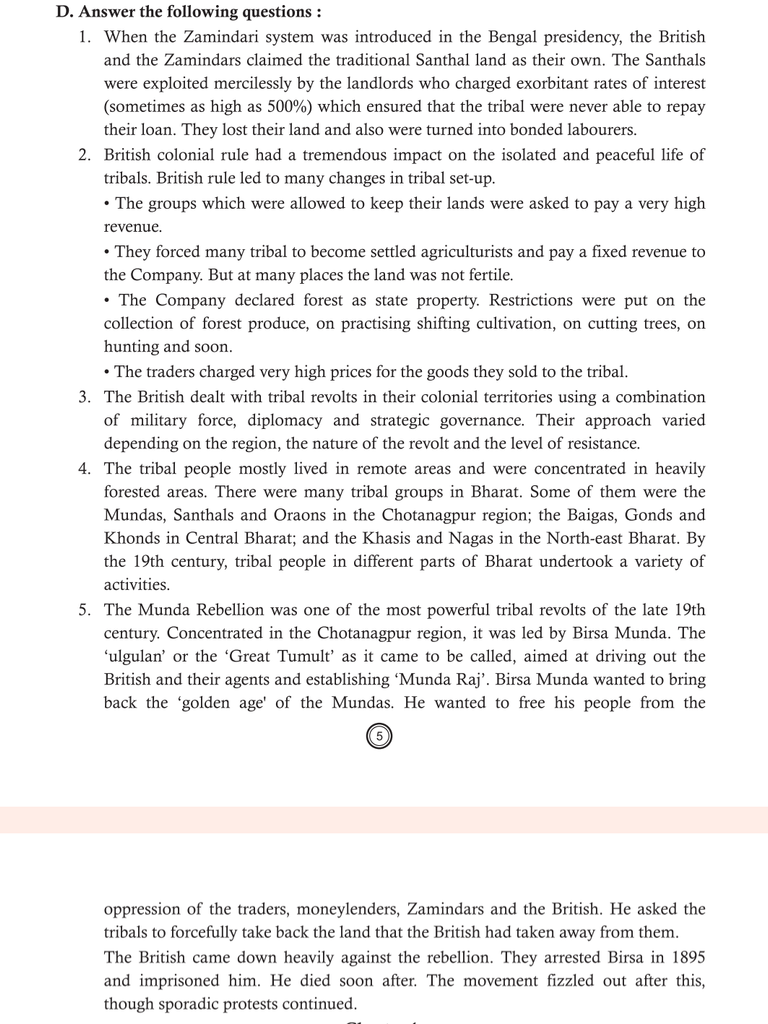
    D. Answer the following questions:

    1.

    What were the reason for Santhal Hul?

    Answer: The Santhal Hul was mainly caused by the exploitation of the Santhals by the British, zamindars and moneylenders, along with the loss of their land and traditional way of life.

    2.

    How did the British rule affected Tribals life?

    Answer: British rule affected tribal life by restricting their access to forests, taking away their land and livelihood, and bringing moneylenders, traders and landlords who exploited them.

    3.

    How did British deal with the tribal revolts.

    Answer: The British mainly suppressed tribal revolts through military force, arrests and severe punishments. Later, they introduced certain administrative and legal changes to control tribal areas and prevent further rebellions.

    4.

    What was the way of life of various tribals in 19th century?

    Answer: In the 19th century, tribal people mainly depended on forests, land and animals for their livelihood. They practised shifting or settled cultivation, hunting, gathering, herding and other traditional occupations.

    5.

    Where and when the Munda Rebellion happened? Who was the leader of the revolt?

    Answer: The Munda Rebellion took place in the Chotanagpur region in 1899–1900. Its leader was Birsa Munda.