Category: Class-7th English Olivia

  • Ch.13 Vocation

    Vocation

    Class 7 English Literature

    Poet: Rabindranath Tagore

    Part 1: Difficult Words and Their Meanings

    1. Vocation

    English Meaning: A job or occupation that a person does or feels suited for.

    Hindi Meaning: व्यवसाय, पेशा

    2. Gong

    English Meaning: A large metal disc that produces a loud sound when struck.

    Hindi Meaning: धातु का बड़ा घंटा या घड़ियाल

    3. Hawker

    English Meaning: A person who sells goods by moving from place to place or calling out in the street.

    Hindi Meaning: फेरीवाला

    4. Crystal

    English Meaning: A clear, transparent mineral or glass-like material.

    Hindi Meaning: स्फटिक, पारदर्शी चमकीला पदार्थ

    5. Lane

    English Meaning: A narrow road or street.

    Hindi Meaning: गली, संकरी सड़क

    6. Spade

    English Meaning: A tool with a flat blade used for digging the ground.

    Hindi Meaning: फावड़ा

    7. Soil

    English Meaning: The upper layer of the earth in which plants grow.

    Hindi Meaning: मिट्टी

    8. Task

    English Meaning: A piece of work that someone has to do.

    Hindi Meaning: कार्य, काम

    9. Baked

    English Meaning: Exposed to strong heat, especially the heat of the sun.

    Hindi Meaning: तेज गर्मी से तपना

    10. Lantern

    English Meaning: A portable lamp, often protected by glass or a covering.

    Hindi Meaning: लालटेन

    11. Shadow

    English Meaning: A dark shape formed when an object blocks light.

    Hindi Meaning: परछाईं, छाया

    12. Unravel

    English Meaning: To discover or explain something that is difficult to understand.

    Hindi Meaning: रहस्य सुलझाना, समझना

    Part 2: Comprehension

    A. Answer the following questions.

    1. Who is ‘I’ in the poem? Identify a line of the poem to prove your answer.

    Answer: The speaker ‘I’ is a school-going child. The line “I wish I were a hawker” shows that the child imagines himself doing different jobs. He also mentions returning from school and being sent to bed by his mother.

    2. Who does he see in the morning, afternoon and in the night?

    Answer: In the morning, the child sees a hawker selling bangles. In the afternoon, he sees a gardener digging the ground. At night, he sees a watchman walking up and down the street with his lantern.

    3. Do you think he has made up his mind as to what he wants to become? How do you know?

    Answer: No, the child has not made up his mind about what he wants to become. He wishes to be a hawker in the morning, a gardener in the afternoon and a watchman at night. This shows that he is attracted to different occupations and imagines the freedom each one offers.

    4. Why does he want to be a bangle seller, gardener and watchman?

    Answer: The child wants to be a hawker because nobody hurries him or tells him when to return home. He wants to be a gardener because he can dig the ground freely without anyone stopping him. He wants to be a watchman because he can walk through the streets at night and chase shadows with his lantern. He admires the freedom these workers seem to enjoy.

    Part 3: Appreciation

    1. In the poem, the poet has used words to form three different visual images. Which stanza do you like the most and why?

    Answer: I like the stanza about the gardener the most. I can imagine the gardener digging the ground with his spade and getting his clothes dirty. I like this stanza because the gardener appears to work freely without anyone stopping him. The description creates a clear picture of his daily life.

    2. Identify the simile in the poem.

    Answer: The simile in the poem is:

    “The street-lamp stands like a giant with one red eye in its head.”

    The poet compares the street-lamp to a giant with one red eye. The word “like” is used to make this comparison. Therefore, it is a simile.
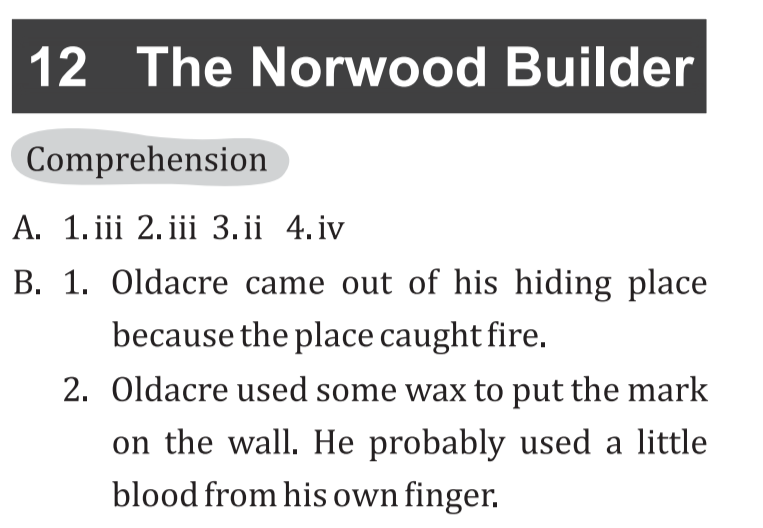
  • Ch.12 The Norwood Builder

    Based on NEP 2020

    📚 New Words

    panicky: frightenedघबराया हुआ
    arrest: take into custodyहिरासत में लेना
    infeasible: impossibleअसंभव
    exterminate: killमार डालना / नष्ट करना
    malicious: nastyदुर्भावनापूर्ण / दुष्ट
    will: the declaration of a person’s wishes regarding the disposal of his or her property after death वसीयत — मृत्यु के बाद सम्पत्ति के बँटवारे से सम्बन्धित कानूनी घोषणा
    gag: jokeमज़ाक
    query: questionप्रश्न / पूछताछ
    arrogantly: proudlyघमण्डपूर्वक
    imperative: importantमहत्त्वपूर्ण / अनिवार्य

    C. Think and Answer

    1. How did the old woman help Oldacre?

    The old woman helped Oldacre by keeping his secret and assisting him in making others believe that he had been murdered. She helped him create false evidence to frame Hector McFarlane.

    © abhishek.io.in

    Class 7 English – Chapter Activities

    A. Vocabulary – Professions

    Put each profession under the correct branch.

    Education Medical Commerce Media Technical
    Teacher Veterinary Doctor Chartered Accountant Journalist Technician
    Professor Pathologist Finance Analyst Editor Civil Engineer
    Principal Orthopaedic Surgeon Company Secretary Copy Writer Maintenance Engineer
    Dean Ophthalmologist Sales Manager Video Editor Chemical Engineer
    Librarian Cardiologist Administrative Officer Advertisement Officer Production Manager

    B. Fill in the Blanks with the Correct Form of Future Tense

    1. He __________ (leave) by the time you get to his house.

    Answer: He will have left by the time you get to his house.

    2. They __________ (come back) by Friday afternoon.

    Answer: They will have come back by Friday afternoon.

    3. Chandni __________ (won’t finish) getting her hair done by noon.

    Answer: Chandni won’t have finished getting her hair done by noon.

    4. I __________ (come) to see you on Sunday.

    Answer: I will come to see you on Sunday.

    5. His father __________ (working) the whole day tomorrow.

    Answer: His father will be working the whole day tomorrow.

    6. The first train __________ (departing) at 5.30 a.m.

    Answer: The first train will be departing at 5.30 a.m.

    7. __________ (close) the door?

    Answer: Will you close the door?

    8. We __________ (will be marry) for one year in October.

    Answer: We will have been married for one year in October.

    9. There __________ (will be) another conference next.

    Answer: There will be another conference next.

    10. __________ (will passing) the post office on your way home?

    Answer: Will you be passing the post office on your way home?

  • Ch.11 Louise Answer Key

    Based on NEP 2020

    📚 New Words

    dowager
    :
    a widow with a title
    उपाधि प्राप्त विधवा महिला
    coquetted
    :
    a woman who flirts
    इठलाकर प्रेम-भाव दिखाने वाली महिला
    queried
    :
    questioned
    प्रश्न किया / पूछा
    reticence
    :
    silence
    मौन / चुप्पी / संकोच
    dishevelled
    :
    untidy
    अस्त-व्यस्त / बिखरा हुआ
    jaunty
    :
    jolly
    खुशमिज़ाज / प्रसन्नचित्त
    conviction
    :
    belief
    विश्वास / दृढ़ विश्वास
    odious
    :
    hateful
    घृणित / नफ़रत के योग्य
    vigorous
    :
    energetic
    ऊर्जावान / जोशीला
    irreverently
    :
    rudely
    अश्रद्धापूर्वक / असम्मानपूर्वक
    initiative
    :
    inventiveness
    पहल / नए विचार करने की क्षमता
    absurd
    :
    silly
    बेतुका / मूर्खतापूर्ण
    spruce
    :
    neat
    साफ-सुथरा / सलीकेदार
    flamboyant
    :
    flashy
    भड़कीला / दिखावटी
    epigrams
    :
    saying
    सूक्तियाँ / संक्षिप्त ज्ञानवर्धक कथन
    📌 Note: The meaning printed for “dowager” in the textbook is “a widow with a title”. This refers to a widow who holds a particular title or rank.

    📖 Class 7 English – Louise

    Student-Friendly Answers & Practice Work

    A. Choose the Correct Option

    1. Louise was finally found:
    i. at Mornay’s in Regent Street.
    ii. at home upstairs reading to the second kitchenmaid who had neuralgia. ✓
    iii. at Sloane Square with two tickets for Happy Sunday Evening.
    iv. at Westminster Abbey.
    Answer: ii. Louise was finally found at home, upstairs, reading the Faerie Queene to the second kitchenmaid who was suffering from neuralgia.
    2. Dowager Lady Beanford did not like the idea of leaving Louise at Harrod’s house because:
    i. Louise never showed any initiative.
    ii. It was a very crowded place.
    iii. She did not want an unprincipled person to converse with her. ✓
    iv. She did not like strangers.
    Answer: iii. Jane was worried that Louise might get into conversation with some unprincipled stranger if she were left in such a place.
    3. Lord Carrywood did not want nieces to be left behind because he thought:
    i. that it was out of fashion to do so. ✓
    ii. only cards should be left.
    iii. the footman would not mention it.
    iv. houses in Berkeley Square did not have accommodation for them.
    Answer: i. Lord Carrywood believed that leaving nieces behind was not a fashionable thing to do.
    4. Jane felt she had been unusually clever because she had:
    i. remembered to match the silk at Harrod’s.
    ii. called the people she meant to call and shopped for what she wanted. ✓
    iii. forgotten to do only one important thing.
    iv. the reputation of being the most absent-minded woman.
    Answer: ii. Jane felt unusually clever because she had completed almost all the tasks she had planned for the afternoon.

    B. Answer the Following Questions

    1. List the things Jane forgot that afternoon.
    Answer:

    Jane forgot several things during the afternoon. They included:

    1. Louise, her niece.
    2. The silk she had been dealing with.
    3. The pattern she needed while trying to match the silk.
    4. Two theatre tickets at Mornay’s.

    Her greatest mistake was forgetting where she had left Louise.

    2. List the number of places Jane Thropple went that afternoon.
    Answer:

    Jane went to several places while trying to remember where she had left Louise. The important places mentioned in the lesson are:

    1. Lord Carrywood’s house.
    2. Harrod’s.
    3. Selfridge’s.
    4. Ada Spelvexit’s house.
    5. Mornay’s in Regent Street.

    Thus, five main places are mentioned in connection with Jane’s afternoon search.

    C. Think and Answer

    Which part of the lesson did you find humorous? Why?
    Answer:

    I found the part where Jane kept trying to remember where she had left Louise the most humorous. She confidently believed that she had completed everything perfectly, but then realised that she had forgotten her own niece. She kept remembering different places and repeatedly changed her guess about where Louise might be.

    The situation becomes funny because Jane is very confident about being unusually clever, while her absent-mindedness creates one problem after another. The conversation between Jane and the dowager makes the scene even more amusing.

    📚 Vocabulary – Similes

    A simile is a comparison between two different things using words such as “like” or “as”.

    The lesson already contains similes such as:

    1. like a trout
    2. like a geranium bed
    3. like epigrams

    Ten More Similes

    1. She was as busy as a bee.
    2. The child ran like the wind.
    3. He was as brave as a lion.
    4. The water was as clear as glass.
    5. Her smile was like sunshine.
    6. The old man was as gentle as a lamb.
    7. The stars shone like diamonds.
    8. He slept like a log.
    9. The news spread like wildfire.
    10. The little girl was as busy as a bee.

    ✍️ Creative Writing

    Write the story of “The Thirsty Crow” using at least two similes.

    The Thirsty Crow

    One hot summer day, a crow was flying over a village in search of water. He was very thirsty and tired. At last, he saw a pot near a house. He flew down and looked inside it.

    There was some water at the bottom of the pot, but the water level was too low for the crow to reach. The crow thought for a while. His clever mind worked like a sharp knife.

    He saw some small stones lying nearby. He picked up the stones one by one and dropped them into the pot. Slowly, the water level rose. The crow was as happy as a child receiving a gift.

    When the water came near the top, the crow drank the water and flew away happily.

    Moral: Where there is a will, there is a way. Intelligence and patience can help us overcome difficulties.

    ⭐ Quick Revision

    • Louise: Jane’s niece whom she accidentally forgot.
    • Jane Thropple: A very absent-minded woman.
    • Dowager Lady Beanford: Jane’s companion in the conversation.
    • Main humour: Jane keeps forgetting where she left Louise.
    • Simile: A comparison using “like” or “as”.
    • Theme: The lesson humorously presents forgetfulness and absent-mindedness.

    📝 Past Tense – Fill in the Blanks

    Correct Answers with Student-Friendly Explanations

    1. They had finished their dinner when I arrived to join them.
    2. The weather was fine.
    3. When she saw me, I looked at the trees.
    4. I arrived at the cinema after the film had started.
    5. Jack was reading a book.
    6. After I had eaten five apples, I felt ill.
    7. I was talking to my neighbour yesterday.
    8. It had stopped raining when I bought an umbrella.
    9. The whole house had burnt down when the firemen got there.
    10. The buses were crowded yesterday due to the rains.

    📚 Quick Grammar Revision

    Past Simple: Used for an action that happened and finished in the past.
    Example: The weather was fine.

    Past Continuous: Used for an action that was in progress at a particular time in the past.
    Example: Jack was reading a book.

    Past Perfect: Used for an action that happened before another past action.
    Example: The film had started before I arrived.

    Past Perfect Continuous: Used for an action that had been continuing for some time before another past event. It is not required in these ten questions.

    💡 Easy Rule: When two actions happened in the past, use Past Perfect (had + V³) for the action that happened first and Past Simple for the action that happened later.
    📌 Exam Tip: In short-answer questions, write the answer in complete sentences. Mention the important reason or event from the lesson rather than giving only one or two words.
  • 📖 “Hope” is the thing with feathers Guide

    “Hope” is the thing with feathers—
    👉 “होप” इज़ द थिंग विद् फेदर्स—

    That perches in the soul—
    👉 दैट पर्चिज़ इन द सोल—

    And sings the tune without the words—
    👉 ऐन्ड सिंग्ज़ द ट्यून विदाउट द वर्ड्ज़—

    And never stops—at all—
    👉 ऐन्ड नेवर स्टॉप्स—ऐट ऑल—

    And sweetest—in the Gale—is heard—
    👉 ऐन्ड स्वीटिस्ट—इन द गेल—इज़ हर्ड—

    And sore must be the storm—
    👉 ऐन्ड सोर मस्ट बी द स्टॉर्म—

    That could abash the little Bird
    👉 दैट कुड अबैश द लिटल बर्ड

    That kept so many warm—
    👉 दैट केप्ट सो मेनी वॉर्म—

    I’ve heard it in the chillest land—
    👉 आइव हर्ड इट इन द चिलिस्ट लैन्ड—

    And on the strangest Sea—
    👉 ऐन्ड ऑन द स्ट्रेंजिस्ट सी—

    Yet, never, in Extremity,
    👉 येट, नेवर, इन इक्‍स्ट्रीमिटी,

    It asked a crumb—of Me.
    👉 इट आस्क्ट अ क्रम—ऑफ मी।

    🔊 नाम का उच्चारण

    Emily Dickinson
    👉 एमिली डिकिन्सन

  • Chapter-10, “Hope” is the thing with Feathers

    Chapter-10, “Hope” is the thing with Feathers

    English Literature

    Poem – “Hope” is the Thing with Feathers

    A. Fill in the Blanks

    1. The poet compares ‘Hope’ to a bird which lives in the soul of a person.
    2. The bird sings a tune and never stops; Hope also lives on.
    3. The bird sings the sweetest song in the gale, in the same way hope brings joy to the person.
    4. The storm is so angry, like life, that it humiliates the little bird, which keeps everyone warm.
    5. Hope, like the bird, faces the chillest of lands, the strangest of seas and other extremities but does not give up or ask for anything.

    Appreciation

    Identify the metaphors in the poem.

    Answer:
    • “Hope” is the thing with feathers.
    • Hope is compared to a little bird.
    • The soul is compared to the bird’s resting place where hope perches.