A.
- c.
- b.
- d.
- d.
- a.
B.
- minerals, surface water, population.
- uninhabitable
- sparsely
- humans
- Poor, reduced
- human activities
- degradation
- ownership
- swamps, marshes, freshwater
- hydroelectricity, greenhouse
C.
- T
- F
- T
- F
- F
D.
- a.
- c.
- d.
- b.
- e.
E.
a. Land cover: it is the physical elements like vegetation, buildings, water that covers the land. It depends on the physical factors like topography, climate, availability of water, soil or minerals.
b. Soil profile: the different layers of the soil like the topsoil, the sub soil and the bed rock is called the soil profile.
c. Community land: community land is owned and used by the whole community for different purposes like parks, roads, forests etc.
d. Mulching: it is a simple and a beneficial practice to stabilize soil temperature, retain soil moisture and to reduce soil erosion. It is like a protective layer spread on top of the soil with material that is both organic and inorganic.
e. Humus: the first layer of the soil, which is extremely fertile, is called the humus.
f. Rainwater harvesting: it is the most popular way of conserving water especially in the urban areas. In this, the rainwater is collected on the roofs of the buildings and then stored underground for later use.
- The factors that define the land use pattern are mostly the physical factors like topography, climate, and availability of water, soil and minerals.
- Result of land degradation on human life is huge as land productivity goes down leading to uncertainty about food causing migration and general degradation of the ecosystems.
- Diagram Given
- Water is available to us in three forms — liquid (oceans, rivers and lakes), gaseous (water vapour in the atmosphere) and solid (ice in the mountains and Polar Regions).
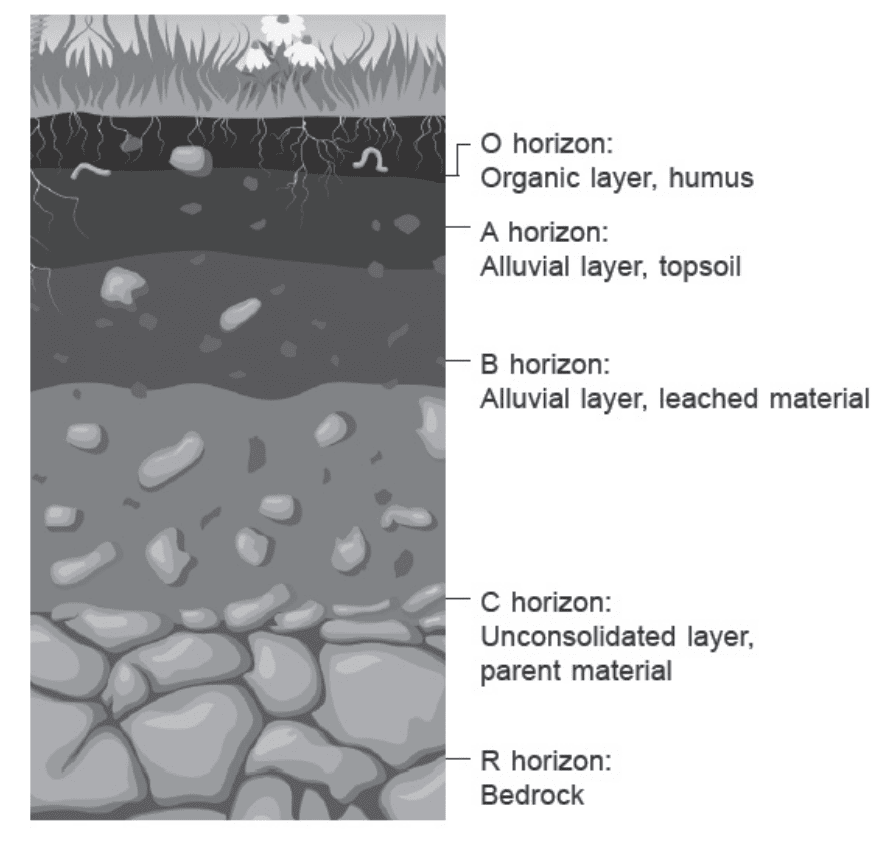
F.
- The various factors that determine the formation of soil at a particular place are as follows-
• Parent rock- which means the original rock from which the soil is formed, which determines the type of mineral content, texture, colour, chemical properties and permeability.
• Climate- places with warm temperatures and with steady and abundant supply of water speed up the formation of soil.
• Time- soil takes thousands of years to form, involving a huge amount of time. This leads to the soil changing its colour as well as its properties over a period of time.
• Topography- this means the physical features like the slope and the steepness of the land which in turn influence the rate at which water flows into or off the soil. For instance a lot of heat and moisture gets trapped in the soil in the plains thus making it richer and fertile. - The following practices are used to control soil degradation like-
• Ground cover vegetation – which minimizes the erosion of the top soil due to the action of the wind and water.
• Mulching – which helps in stabilizing the soil temperature, retaining soil moisture and stopping soil erosion. In this method, both organic and inorganic material is used to create a layer that protects the top soil.
• The contour farming – which is done in a variety of ways like creating contour barriers and contour ploughing, both of which are carried out to stop the erosion of the top soil in the hilly areas by ploughing along the contour slopes.
• Intercropping – this is another method of growing two or more crops over the same land in the same growing season, with one crop that grows fast and the other that grows slowly.
• Terrace farming – in this farming, crops are grown on the step like formations along the sides of the slopes in order to prevent or reduce the run off of rain water and carrying of soil with it.
• Crop rotation – in this method of farming two or more than two crops are grown one after the other in a regular sequence, on the same land. This helps in controlling the insects and the diseases along with preserving the soil nutrients.
• Drip irrigation – in this water is slowly released to each plant in order to conserve water as well as prevent run off with too much of water.
• Shelter belts or windbreaks – in this, one or more rows of trees or shrubs are planted, along the field to prevent soil erosion as well as shelter from the wind. - The various ways in which water is used in the present times are as follows-
• In agriculture, where nearly 70% of water is used for irrigation. The problem is it is being used at a faster rate than it can be replenished with.
• Hydroelectricity- large scale river valley projects is yet another way of using water. It helps in providing water for irrigation, generates hydroelectricity and controls flood water.
• Industry- water is also required in the industrial sector and in developed countries; the concentration of water is more in the industrial sector.
• Besides these, water is also used for drinking, cooking, washing clothes and utensils, bathing and other household uses. Water is also used for transportation and for recreational functions. - The following factors have led to the scarcity of water-
• Uneven distribution of water throughout the world, causing scarcity of fresh water in most places despite heavy rainfall.
• Construction of buildings and plantations over swamps and marshy areas has also led to scarcity of water.
• Climate change is a big factor as it has turned many places into dry places.
• Unchecked population growth is probably the most important factor behind growing scarcity of water throughout the world.
• Existing water bodies are constantly being polluted by domestic sewage, organic waste, plant nutrients, toxic chemicals, sediments, heat, oil and radioactive substances that flow into them. This makes water unfit for human consumption as well as it disturbs the ecological balance. - Here are some steps being taken by different countries to conserve water and its quality.
• Water reuse and recycling
• Seawater desalinisation
• Protection of wetlands
• River cleaning to improve quality of water
• Afforestation to reduce run-off
• Rainwater harvesting
• Encouraging better irrigation practices
• Addressing causes of pollution
G.
- Deforestation refers to the deliberate clearing of forests or wooded areas, often for agriculture, logging, or urban development, leading to the permanent loss of forest cover and biodiversity. It contributes to habitat destruction, loss of carbon sinks, and soil erosion, impacting local and global ecosystems negatively.
Afforestation, on the other hand, involves the deliberate planting of trees and establishment of forests in areas where there were none previously. It aims to increase forest cover, restore degraded lands, enhance biodiversity, and provide ecosystem services like carbon sequestration, soil conservation, and water regulation. - Landslide refers to the sudden and rapid movement of a large mass of rock, debris, or soil down a slope, often triggered by heavy rainfall, earthquakes, or human activities. It can result in significant damage to infrastructure, loss of life, and disruption of communities in affected areas.
Soil erosion, on the other hand, is the gradual wearing away of soil by wind, water, or human activities like farming and construction. It occurs over time and leads to the loss of fertile topsoil, reducing agricultural productivity and increasing sedimentation in water bodies, which can harm aquatic ecosystems. - Private land is used and owned by a person or a group of people for personal use.
Community land is owned and used by the whole community like parks, roads, forests etc.
H.
- Soil is considered an important resource because it serves as the foundation for global food production, supporting agriculture and sustaining human nutrition.
Beyond its agricultural role, soil is crucial for maintaining biodiversity and ecosystem health, providing habitats for diverse organisms and contributing to ecological balance.
Moreover, soil plays a vital role in regulating water availability and quality, influencing groundwater recharge and flood prevention.
Additionally, soil acts as a carbon sink, helping to mitigate climate change by storing carbon dioxide from the atmosphere.
Overall, soil is integral to both natural ecosystems and human societies, making its conservation and sustainable management essential for future generations. - Soil varies significantly from place to place due to diverse factors such as parent material, climate, topography, vegetation, and time.
The original rock from which soil is formed is called the parent rock. This determines the type of mineral content, texture, colour, chemical properties and permeability.
Climate is one of the most important factors affecting the formation of soil. Warm temperatures, speed up the formation of soil. On the other hand, places with cold climatic conditions like low temperatures and less precipitation slows down soil formation.
Time is another important factor influencing soil formation.
The topography or physical features also affect soil formation. The slope and steepness of the land influence the rate at which water flows into or off the soil. A lot of heat and moisture gets trapped in soil in the plains, thus making it richer and fertile. Hillsides may relatively have thinner soil because of erosion wind and water. - Water supplies vary across the world due to diverse factors such as climate patterns, geographical location, hydrological cycles, and human activities.
Regions closer to the equator generally receive more rainfall compared to those in temperate or polar regions, influencing freshwater availability.
Geographical factors such as proximity to oceans, mountains, and rivers affect local water sources and distribution.
Additionally, variations in hydrological cycles, including seasonal precipitation patterns and groundwater recharge rates, contribute to fluctuations in water availability.
Human activities such as water management practices, irrigation, industrial use, and urbanization further impact water supplies, leading to disparities in availability and quality globally.